
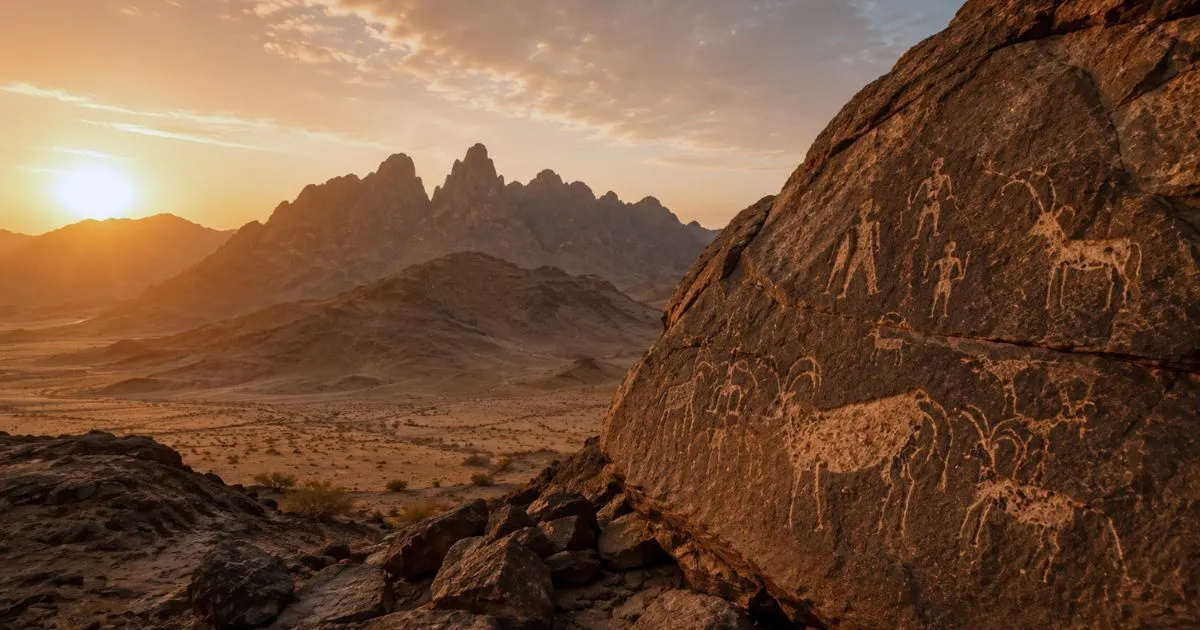
Quick verdict: where the Rat and al-Manjour mountains are
The Rat and al-Manjour mountains lie south of Hail City, roughly 320 km west of Shuwaymis village. Archaeological remains were discovered at the site in 2001.
Their importance is not the geology. It is the rock paintings and carvings, which qualified the site for the UNESCO World Heritage List in 2015.
Site at a glance
| Detail | Information |
|---|---|
| Location | South of Hail City, about 320 km west of Shuwaymis |
| Remains discovered | 2001 |
| World Heritage listing | 2015 |
| Geology | Sandy sedimentary stone dating back 14,000 years |
| Setting | Surrounded by the al-Harrat region, crossed by Wadi Rat |
What the Rat and al-Manjour mountains contain
Rat Mountain carries images that are largely human and animal figures, carved at life size. The scale is deliberate, and it conveys the economic, social and intellectual life of the Thamudic people who made them.
Al-Manjour Mountain is known for camel carvings and drawings. Camels appear again and again in Arabian rock art, and the animal’s long standing role is set out in the guide to the Arabian camel.
Landscape around the Rat and al-Manjour mountains
The archaeological site sits on sandy sedimentary stone dating back 14,000 years, surrounded by the al-Harrat region, with a valley known as Wadi Rat running through it. Volcanic terrain nearby is covered in the caves and harrat of Hail Province.
The UNESCO listing
The 2015 inscription placed this rock art among the Kingdom’s recognized World Heritage properties. The official inscription file is available from UNESCO.
The listing covers the wider Hail rock art landscape, so the site is usually visited together with the other icons described in the heritage town of Al-Ghazalah. Protection and site management fall under the Heritage Commission.
Visiting and context
This is desert travel, so plan transport and timing rather than improvising. Northern heritage routes often combine Hail with Al-Jawf Province and its provincial museum.
For a broader chronology of the region and its settlements, readers usually start with the history of Saudi Arabia, then look at living traditions recorded in Saudi intangible cultural heritage.
Final verdict
Two mountains, one listing, and a 14,000 year old rock canvas. If you are choosing between Hail sites, this one delivers the deepest time depth and the clearest link to the people who lived there.
