
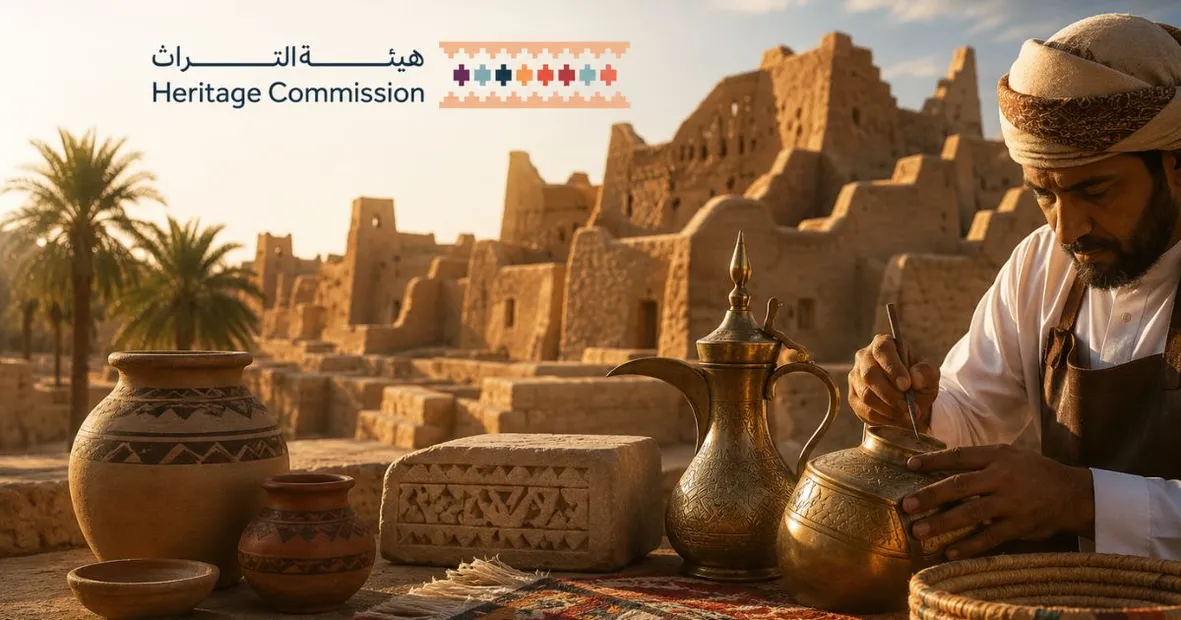
The Heritage Commission handles everything connected to the heritage and antiquities sector in Saudi Arabia: protection, exploration, maintenance, restoration, and long-term management. Its mandate reaches across villages, cities, neighborhoods, crafts, traditional industries, heritage buildings, historical monuments and intangible heritage.
It was established in 2020 as one of eleven cultural commissions approved together by the Council of Ministers and attached to the Ministry of Culture.
How the Heritage Commission is organized
The commission holds a general legal personality with financial and administrative autonomy, funded through an annual operating budget inside the Ministry of Culture’s budget. It reports organizationally to the Minister of Culture, and its employees fall under the Labor Law and the Social Insurance Law.
Operations run from headquarters in Riyadh. A board of directors chaired by the Minister of Culture approves plans and oversees strategy, while a chief executive appointed by the board manages daily affairs.
The logo
The commission’s logo uses Arabic embellishment art inspired by al-Sadu motifs, a direct nod to the weaving tradition documented in our guide to al-Sadu weaving. Its colors follow the visual language of the Ministry of Culture identity.
Mandates and licensing
Its responsibilities include developing national heritage and raising public interest in it, protecting heritage from disappearance, organizing conferences and exhibitions, representing the Kingdom in regional and international bodies, building a heritage sector database, licensing activities within its scope, and encouraging individuals and companies to produce heritage content. Several of these threads connect with the Saudi intangible cultural heritage listed with UNESCO.
Discoveries and programs
In 2020 the commission announced results from an archaeological survey by a joint Saudi and international team: human, elephant, and predatory animal footprints near an ancient dried lake on the outskirts of Tabuk Province, dating back more than 120,000 years. It stands as early scientific evidence of human presence on the Arabian Peninsula and offers a view of the ecosystem during that migration period.
The same year, a scientific team documented stone structures in the Nafud desert used as animal traps, among the oldest known anywhere, dating back over seven thousand years. Also in 2020, the commission partnered with the Google Skillshop platform on a Digital Marketing Skills for Artisans program targeting two thousand artisans.
In 2023 it identified and documented the first two Dadanitic inscriptions recorded in al-Qassim Province, at an archaeological site called al-Dulaymiyah, one in early Dadanitic script and one in late. That year it also completed excavation at the Halit site in al-Dawadimi Governorate, a mining location dating to the Umayyad era and known in early sources as Maadin al-Najadi.
Heritage villages and towns
Restoration work extends to inhabited heritage settlements such as the heritage town of al-Ghazalah in Hail and the heritage town of Uyun al-Jiwa in Qassim, as well as major sites including al-Turaif District and the historical buildings of Jeddah.
Strategy
Launched in September 2021, the commission’s strategy rests on eight pillars, beginning with effective protection, preservation, and management of cultural wealth and archaeological assets.
Key takeaways
- The commission was established in 2020 under the Ministry of Culture.
- Headquarters are in Riyadh, with a board chaired by the Minister of Culture.
- Tabuk footprint discoveries date back more than 120,000 years.
- Its strategy, launched in September 2021, is built on eight pillars.
Frequently asked questions
What does the Heritage Commission cover?
Antiquities, heritage buildings, historical monuments, traditional crafts and industries, heritage villages and neighborhoods, and intangible heritage.
Who supervises it?
The Minister of Culture, who also chairs its board of directors.
What was found in Tabuk Province?
Human, elephant, and predatory animal footprints near an ancient dried lake, dating back over 120,000 years.
Does it support artisans?
Yes. Programs include the Digital Marketing Skills for Artisans training launched with Google Skillshop for two thousand participants.
The bottom line
The commission is the single reference point for anyone dealing with Saudi antiquities, from excavation permits to craft training. Full details are published by the Heritage Commission.
