
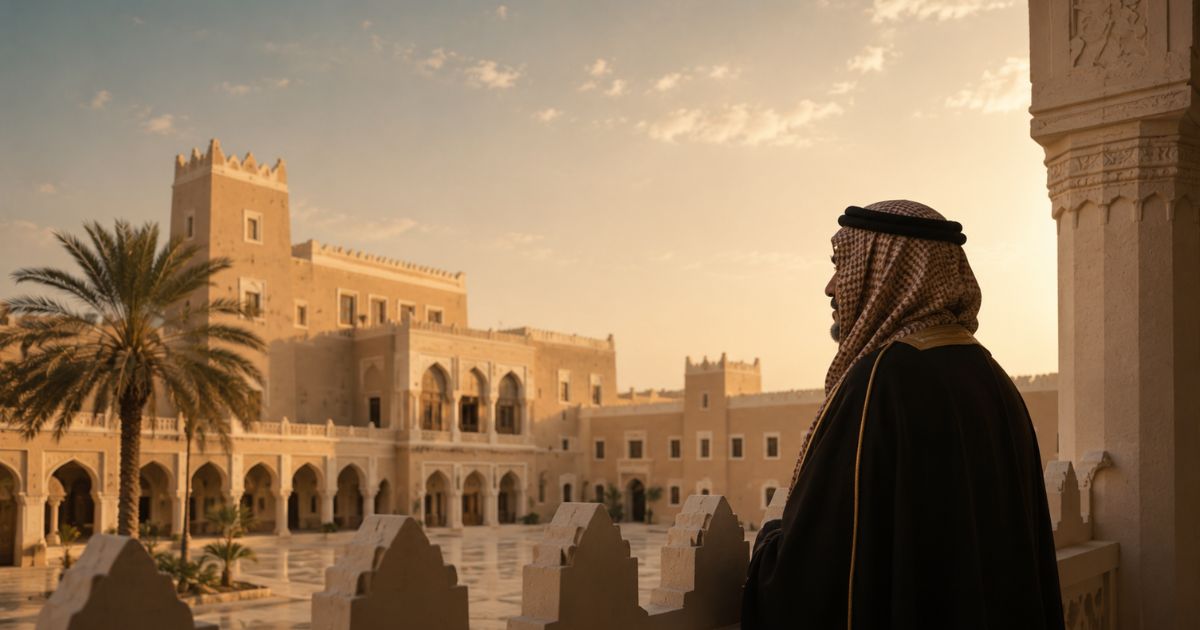
The palaces of King Abdulaziz are not simply old buildings. Each one hosted decisions, negotiations and ceremonies that shaped the Kingdom of Saudi Arabia, and together they trace the founder’s movement across the country he unified. Their value is historical, architectural and heritage based and several are still standing today.
Why These Palaces Matter
Founding King Abdulaziz bin Abdulrahman Al Saud governed a vast territory long before modern transport made that simple. The residences he built and occupied doubled as administrative centres, reception halls and family homes. Reading them in sequence gives a practical map of how the early state operated.
Khuzam Palace, Jeddah
Built by order of King Abdulaziz in the heart of Jeddah in 1928, Khuzam Palace followed his earlier stays between Nassif House and the Green Palace in the city. It was among the first buildings in the Kingdom to use cement and steel, a notable break from traditional coral and mud construction.
Its most significant moment was diplomatic and economic: the first and most important oil exploration agreement was signed there. Visitors interested in the period often pair it with Nassif House and the wider set of historical buildings in Jeddah.
Badi’ah Palace, Riyadh
Constructed in 1935 between Wadi Hanifah and Shuaib Umm Qasr in Riyadh, Badi’ah Palace served as a venue for receiving visitors and holding private meetings. Its setting on the wadi placed it just outside the dense old city, which suited a residence built for hosting. The adjoining Badi’ah Palace mosque survives as part of the complex.
Qubbah Palace, Qassim
This historical palace in Qassim Province took several years to complete because building materials had to be brought in from outside the region, carried on the backs of camels and pack animals. Its importance is geographic. The location links five administrative provinces, making it a natural stopping point on routes across the interior, close to historic corridors such as the Basra to Makkah route stations in Qassim.
A’ali Palace, Eastern Province
Built in 1936 in Qaryat al-Ulya Governorate in the Eastern Province, A’ali Palace was designed to sit among the local ruling palaces of the era. Its site was chosen because of heavy traffic through the area, which made it useful as a point of contact between the administration and travellers.
The Historic King Abdulaziz Palace, Rafha
In Rafha Governorate in the Northern Borders Province stands a palace built from mud and adobe. The structure is rectangular with circular towers and covers 4,320 square metres. Inside are a water well, a mosque, a section for managing emirate affairs and a designated area for horses.
That layout says a great deal about its function. Water, worship, administration and transport were all provided on site, the same self contained logic found in defensive heritage sites such as the Ad-Dilam wall and the historical castles around Riyadh.
Murabba Palace, Riyadh
Murabba Palace was built in 1936 as a group of palaces inside a single wall outside Riyadh, which is where its name comes from. King Abdulaziz and his family moved there in 1938.
It became the working centre of the state in its most formative years. There he received several Arab heads of state and issued decisions that still define the country, including the issuance of Saudi currency, the establishment of formal schools and the creation of the railway. The complex today forms part of the King Abdulaziz historical palace site in al-Murabba, next to the national museum district.
Visiting the Sites Today
Several of these palaces are conserved and interpreted as heritage destinations under the Heritage Commission, and they pair naturally with related collections such as the rare cars of King Abdulaziz and his private library. Anyone building a Riyadh itinerary can add Masmak Fort for the earliest chapter of the story.
Quick Reference
| Palace | Location | Built |
|---|---|---|
| Khuzam Palace | Jeddah | 1928 |
| Badi’ah Palace | Riyadh | 1935 |
| Qubbah Palace | Qassim Province | Completed over several years |
| A’ali Palace | Qaryat al-Ulya, Eastern Province | 1936 |
| King Abdulaziz Palace | Rafha, Northern Borders | Mud and adobe construction |
| Murabba Palace | Riyadh | 1936, occupied 1938 |
FAQs About palaces of King Abdulaziz
Which palace hosted the first oil exploration agreement?
Khuzam Palace in Jeddah, built in 1928, was the site where the first and most important oil exploration agreement was signed.
When did King Abdulaziz move into Murabba Palace?
In 1938, two years after the complex was built in 1936.
How large is the King Abdulaziz palace in Rafha?
It covers 4,320 square metres and includes a well, a mosque, an administrative section and an area for horses.
Taken together, these six residences follow the founder from the Red Sea coast to the northern border, and each preserves a different part of how Saudi Arabia was governed in its first decades. Archival material is held by the King Abdulaziz Foundation for Research and Archives.
