
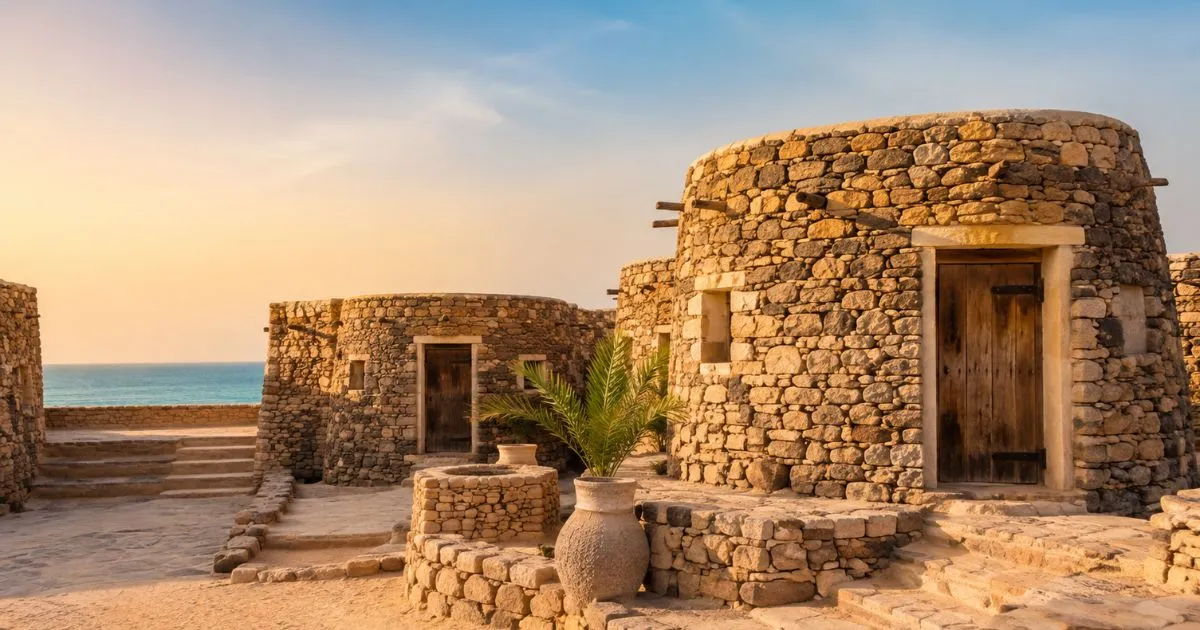
Al-Qassar Heritage Village sits on Farasan Island in Jazan Province, in the far south of the Kingdom. It is known for its dense palm groves and perennial trees and it counts among the first places settled on the island, inhabited hundreds of years ago thanks to a mild year-round climate and reliable fresh water drawn from local wells.
Visiting al-Qassar Heritage Village
The village lies about five km south on Farasan Island, reachable by way of Janaba Corniche and al-Hafah Marina. Its stone and palm-leaf buildings, ringed by palm trees, make it a destination in its own right for travelers exploring Jazan Province.
For residents it has always been a summer retreat. Families spend more than three months there during the stormy period known as al-Assef, when northern summer winds signal the wet tropical season that waters the palms. Groundwater here is unusually shallow, with depths that do not drop below seven m.
Getting to the island
Farasan is the largest Saudi island in the Red Sea and our guide to Farasan Island covers the crossing and what else is worth seeing. Nearby mainland districts such as al-Aridah Governorate round out a southern itinerary.
Ruins and inscriptions
Researchers working in al-Qassar Heritage Village have recorded inscriptions carved into stone in the Himyari script, others in ancient Latin letters, and material in the al-Kadmi area dating to the year twenty-four BC. Writings in the southern Musnad script from the Himyarite era have also been documented, alongside Roman-era remains, drawings, and an old fort from the late Islamic period.
Wells and daily supplies
Water explains the village’s importance to the people of Farasan. Cold wells dug for drinking and irrigation kept the settlement viable, the best known being the Aabida well at the northern entrance. Small shops known as al-Dakakin supplied food to households during the season.
Social life in the village
Marriages on Farasan were often postponed for a year until the season of departure to al-Qassar arrived in summer. That period, called the Shidda season, offered escape from severe heat, with water, fruit, and palm shade in abundance.
Houses were built with stone walls, roofed with wood and palm fronds, and their courtyards were decorated with white sea shells known as al-Batah, covering the surrounding wall surfaces. The walls carried distinctive Persian engravings. Comparable settlement traditions appear in the heritage town of al-Ghazalah in Hail and among the heritage villages around Riyadh.
How the village was built
Al-Qassar is made up of several neighborhoods, each a cluster of stone houses. A single house, called a Bayt, does not exceed twenty m in area and served as a family’s main residence. The village holds around four hundred houses, all walled with carved and trimmed stone. Roofs used palm trunks or Hyphaene wood with palm branches or Anisotes sticks, topped with Khabban, large masses of seaweed.
Palm was the structural material of choice across the region, as our guide to the many types of dates in Saudi Arabia and the coastal craft of al-Qallafah wooden shipbuilding both illustrate.
Restoration
Houses, squares, and archaeological areas have been developed and restored in line with the village’s original urban design, turning it into a cultural landmark that records the annual journey Farasan families made each summer.
Key takeaways
- Al-Qassar sits about five km south on Farasan Island in Jazan Province.
- It contains roughly four hundred stone houses, each up to twenty m in area.
- Inscriptions include Himyari, southern Musnad and Latin scripts, with material dating to 24 BC.
- The Aabida well at the northern entrance is the most prominent water source.
Frequently asked questions
Where is al-Qassar Heritage Village?
On Farasan Island in Jazan Province, about five km south, reached via Janaba Corniche and al-Hafah Marina.
Why did families move there in summer?
To escape intense heat during the Shidda season, when the village offered water, fruit, and palm shade.
How old are the inscriptions?
Some date to the year twenty-four BC, with Himyarite-era Musnad writings and Roman-era remains also recorded.
What were the houses made of?
Carved stone walls with roofs of palm trunks or Hyphaene wood, palm branches, and seaweed masses known as Khabban.
The bottom line
Al-Qassar preserves a full seasonal way of life, not just a set of ruins. Site documentation is maintained by the Heritage Commission.
