
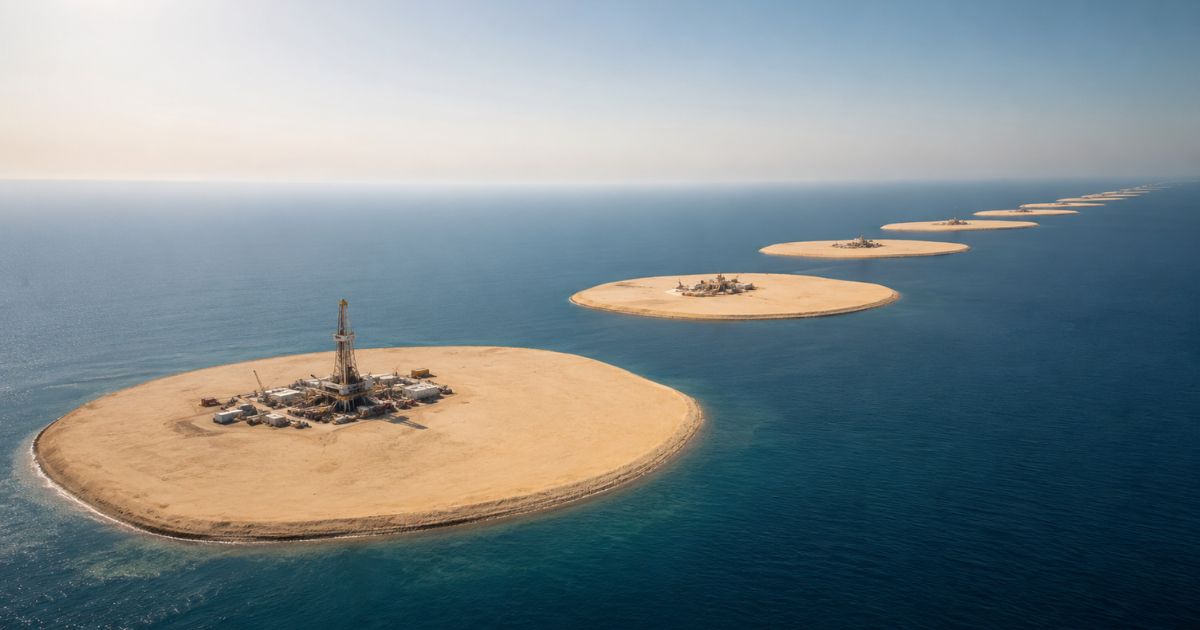
Quick verdict: how many Manifa field artificial islands are there?
There are twenty-seven Manifa field artificial islands. Each is about the size of ten football fields, and all of them were built from forty-five million cubic meters of sand taken from the seabed.
They are connected by a causeway roughly forty-one km long, which turns a shallow offshore field into something drillers can reach by road.
Key figures at a glance
| Detail | Figure |
|---|---|
| Number of islands | 27 |
| Sand used | 45 million cubic meters |
| Causeway length | 41 km |
| Water depth | 1 to 15 m |
| Field discovered | 1957 |
Where the Manifa field artificial islands sit
The Manifa Field lies in a shallow marine area of the Arabian Gulf north of al-Jubayl, with water depths between one and fifteen m. It was discovered in 1957, long before the island design existed.
Shallow water is awkward. It is too deep for simple land rigs and too shallow for conventional offshore platforms and supply vessels, which pushed engineers toward a different answer.
Why the Manifa field artificial islands were built at all
The stated reason is environmental. To avoid damaging a sensitive ecosystem, more than 70 percent of the field was converted into what functions as a terrestrial field, with drilling carried out from the islands rather than from vessels moving across the seabed.
Concentrating activity on fixed pads reduces disturbance across a wide, biologically productive area. Company documentation on the development is published by Saudi Aramco. Similar marine-protection thinking appears in projects such as the mangrove planting scheme in Jubail and the smart buoy in the Arabian Gulf.
What the causeway changes
A forty-one km causeway means crews, equipment and maintenance teams reach wellheads by vehicle. That lowers operating complexity and shortens response times compared with a fully offshore layout.
It also creates a permanent structure in a shallow sea, so water circulation and sediment movement are managed as part of the design rather than treated as afterthoughts.
Manifa in the wider energy picture
Manifa is one chapter in a long production story. Readers who want the timeline should start with the history of Saudi oil production and the role of the Ministry of Energy.
On the economic side, the field feeds refining and export capacity that the Kingdom is now balancing against growth in the non-oil sector and against the industrial cities programme. Investors watching the sector also track the opening of the Saudi stock market to global investors.
Final verdict
Twenty-seven islands is the number to remember, but the design logic matters more. Manifa shows how a shallow, ecologically sensitive field can be developed with land-style operations and it is now a standard reference point in discussions of Saudi resource projects.
