
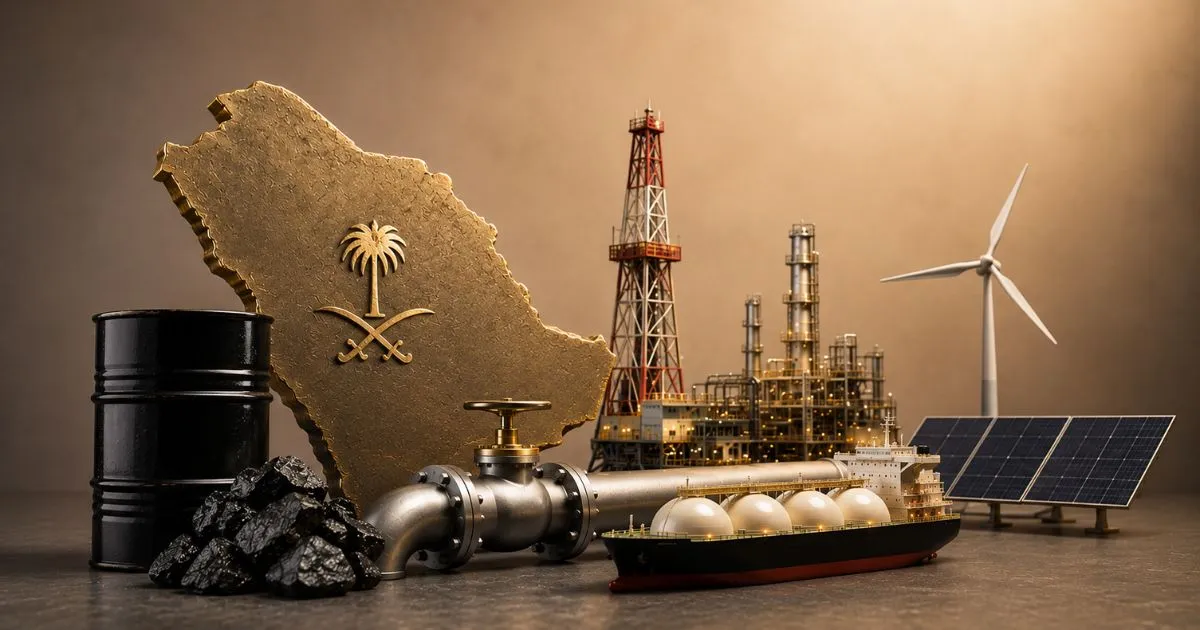
The Saudi Ministry of Energy oversees every part of the energy ecosystem in the Kingdom, from oil and gas exploration through to electricity and renewables. It monitors the work of exploration and production companies and tracks both the Hydrocarbons Strategy, covering oil, gas, refined products and petrochemicals and the Electricity and Renewable Resources Strategy.
Strategic objectives of the Saudi Ministry of Energy
- Leadership in energy markets.
- Security and reliability of supplies.
- Maximizing financial benefits.
- Efficiency in consumption and economic development.
- Enhancing local content.
- Carbon management.
How the ministry took shape
Oil sector regulation dates to the reign of the founder, King Abdulaziz Bin Abdulrahman Al Saud, when the Public Works and Minerals Authority was created in 1935 under the Ministry of Finance. The General Directorate of Petroleum and Mineral Affairs followed in 1952.
The directorate became the Ministry of Petroleum and Mineral Resources in 1960 and kept that name for around fifty-seven years, until it was renamed the Ministry of Energy, Industry and Mineral Resources in 2016. In 2019 a Royal Decree changed the name to the Ministry of Energy, while a separate Ministry of Industry and Mineral Resources was established.
The ministry works from headquarters in Riyadh, and its minister, a member of the Council of Ministers, is appointed by Royal Decree. Over nearly sixty-three years, six ministers led the institution until 2023. Engineer Abdullah Bin Hamoud Al-Tariki was the first Minister of Petroleum and Mineral Resources, appointed in 1960 during the reign of King Saud Bin Abdulaziz Al Saud. The longer arc is covered in this history of Saudi oil production.
Reserves and capacity under the Saudi Ministry of Energy
The Kingdom’s fixed oil reserves are estimated at around 267 billion barrels, more than 20.5 percent of global reserves. Refining capacity exceeds 5.8 million barrels per day locally and globally, and petroleum production capacity is estimated at 12.7 million barrels per day, about 12 percent of world production.
Those figures explain the ministry’s policy of organized production. The petroleum and gas sector remains the pillar of the national economy, and the strategy is built on using hydrocarbon resources to support sustainable development of that economy.
Research centers and training
The ministry supervises several research centers and training institutes founded during its development, including the King Abdullah Petroleum Studies and Research Center (KAPSARC), the Saudi Petroleum Services Polytechnic, and the Higher Institute for Plastics Fabrication.
These institutions feed technical capability back into the sector, alongside graduate programs such as Nokhab.
What the ministry does day to day
It follows up, analyzes and evaluates research and studies submitted by operating companies, and monitors oil and natural gas production to confirm compliance with set policies. It also analyzes information and prepares studies on local and global production, prices, supply and demand.
Beyond hydrocarbons, the ministry regulates the petroleum, gas, refining and petrochemical sectors, develops the electricity sector across traditional, renewable and nuclear sources, and regulates the companies working in it. Consumer-facing effects of that work are visible in the Saudi electricity bill.
It also works on localization and local content, contributing to GDP growth and job creation, improving the balance of payments, identifying risks in the energy system and building plans for emergencies and potential crises.
Climate and carbon
The ministry manages the climate change file, participates in setting strategies for traditional energy, monitors related initiatives, and develops environmental systems and policies for the sector. It supervises implementation of the carbon circular economy framework and develops carbon capture, utilization and storage technologies.
Renewable capacity is expanding in parallel, most visibly in the north, where Al-Jawf hosts major wind and solar assets, and in national programs such as mangrove planting in Jubail.
FAQs About Saudi Ministry of Energy
When did the ministry take its current name?
In 2019, by Royal Decree, when the Ministry of Industry and Mineral Resources was created as a separate entity.
How large are the Kingdom’s oil reserves?
Around 267 billion barrels, more than 20.5 percent of global reserves.
What is KAPSARC?
The King Abdullah Petroleum Studies and Research Center, one of the research bodies supervised by the ministry.
Related coverage
Energy policy shows up across the budget, industry and infrastructure. See the 2026 budget figures, industry and technology, and water resources and dams. Official releases are published by the Saudi Press Agency.
