
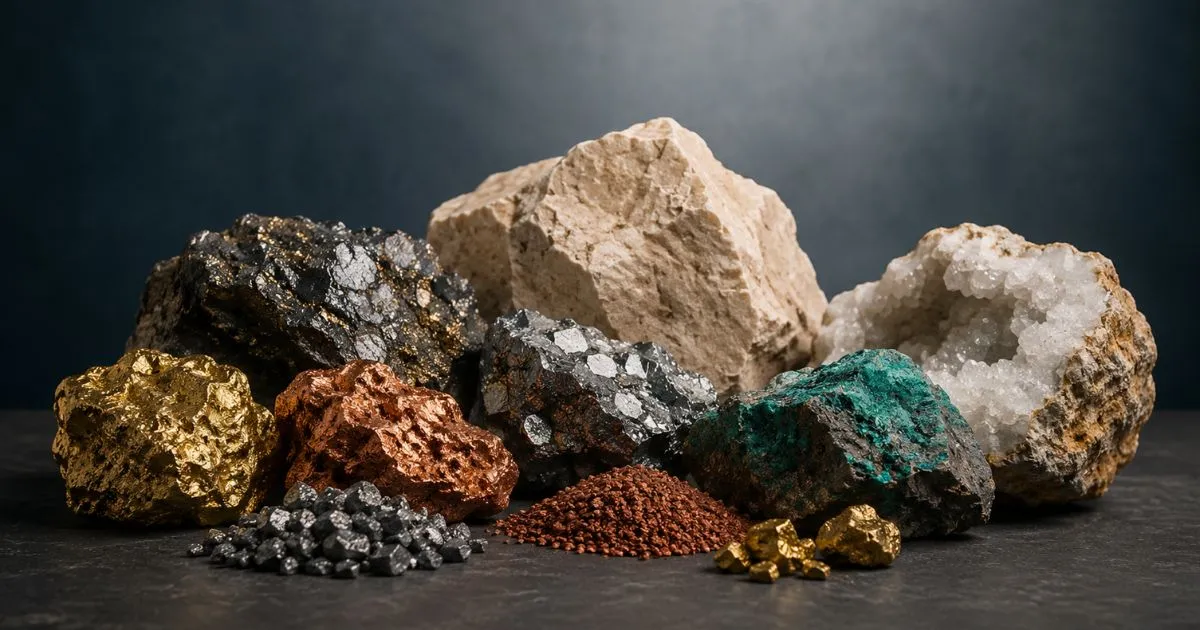
Minerals in Saudi Arabia place the country among the wealthiest in the world for natural resource endowment. It ranks thirteenth globally for the abundance and diversity of its mineral holdings, which include phosphate, gold, copper, zinc, iron ore, uranium, niobium, silver, feldspar, bauxite, silica and limestone.
That breadth matters more than any single commodity. It gives the mining sector room to feed several industrial value chains at once rather than depending on one export.
What minerals in Saudi Arabia support
Production covers metallic minerals such as iron, aluminum, copper, zinc and gold, and non-metallic minerals used in phosphate fertilizers, cement, glass and ceramics. Those downstream links tie mining directly to construction and agriculture.
Forty-eight types of minerals have been identified across more than 5,300 sites, with an estimated value of SAR5 trillion. Domestic manufacturing built on these inputs includes companies such as City Cement and Saudi Ceramic Company.
Annual output of key minerals in Saudi Arabia
- Bauxite: approximately 4.9 million t per year, processed into one million t of aluminum.
- Phosphate ore: 24.6 million t per year, processed into 5.26 million t of phosphate fertilizers.
- Copper and zinc concentrates: 68,000 t per year.
- Gold: 409,000 oz per year from mines in the Arabian Shield region.
The phosphate figures put the Kingdom among the top five producers of phosphate fertilizers globally. Sector detail is available in this guide to phosphate in Saudi Arabia.
The Arabian Shield
Mines in the Arabian Shield region hold both base and precious minerals and they carry the bulk of gold output. Operations there are the backbone of the precious metals side of the industry, as seen at the Al-Hajar gold mine.
Support services around those sites have grown into their own business segment, covered in this profile of Esnad mining services.
Frequently asked questions
How many mineral types have been identified?
Forty-eight, spread across more than 5,300 sites with an estimated value of SAR5 trillion.
How much gold is produced annually?
About 409,000 oz, mainly from mines in the Arabian Shield region.
Where does the Kingdom rank in phosphate fertilizers?
Among the top five global producers, with 24.6 million t of phosphate ore processed into 5.26 million t of fertilizer each year.
Mining and the wider economy
Mining is treated as a third pillar of industry alongside oil and petrochemicals, and its expansion shows up in national economic figures. For context, see industry and technology, non-oil sector growth, the Senaei industrial platform, and the 2026 budget figures. Sector announcements are published by the Saudi Press Agency.
