
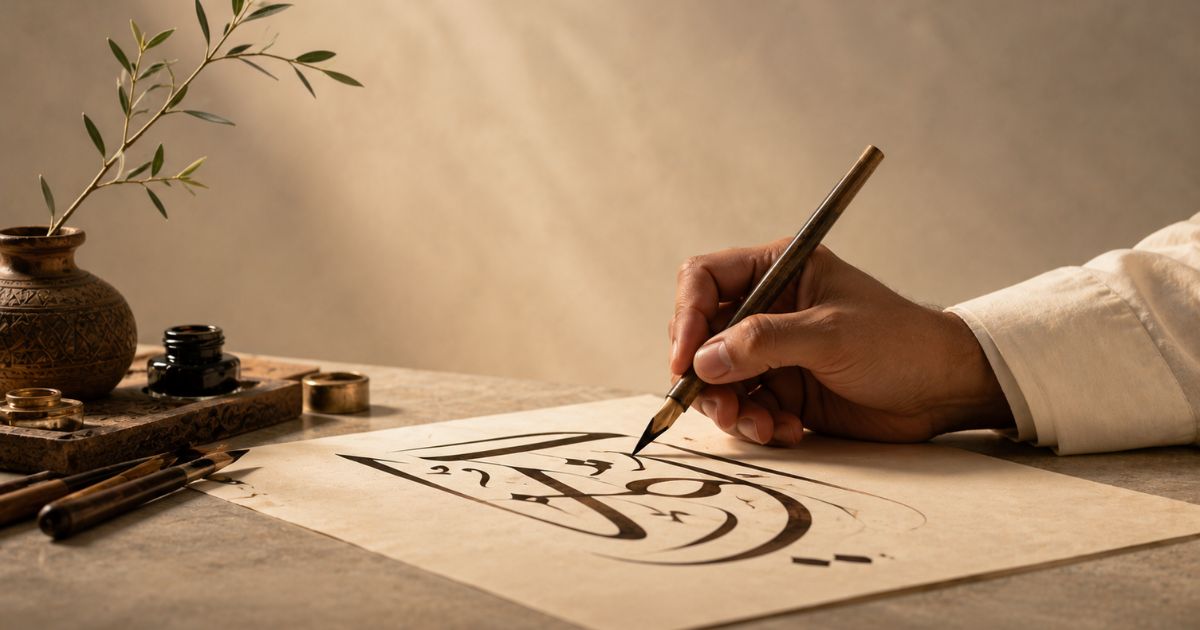
The Year of Arabic Calligraphy was a Saudi cultural initiative that treated a writing system as an art form worth a full national program. Launched by the Ministry of Culture across 2020 and extended for a further year into 2021, it gave Arabic script its own visual identity, its own platform and a calendar of activity built around it.
What the Initiative Set Out to Achieve
The purpose was straightforward: celebrate Arabic calligraphy because of its significance and its close relationship with the Arabic language. Script and language are inseparable here. The forms, history and techniques of calligraphy reflect the richness and creativity of Arabic itself, and the initiative treated calligraphy as a symbol of Saudi identity.
The Kingdom acted as both sponsor and incubator, which meant funding and hosting the work rather than simply endorsing it.
Why the Year of Arabic Calligraphy Ran for Two Years
The initiative began in 2020 and was extended for an additional year until 2021. Extending a cultural year is a practical decision as much as a symbolic one. It gives exhibitions, training and commissions time to complete and it lets an audience build rather than peak once.
Three Strands of Activity
Calligraphy as an art in its own right
Arabic calligraphy was presented as fine art rather than decoration, positioned alongside the visual arts programming seen at events such as the JAX art festival in Diriyah.
Spreading the culture of using it
The program worked to make calligraphy familiar to beginners, not only to specialists, which is where the teaching platform mattered most.
Supporting gifted calligraphers
Practitioners with genuine talent received support, in line with the wider approach to craft visible in projects like the traditional handicrafts of Aseer Province and the art of al-Qallafah wooden shipbuilding.
The al-Khattat Platform
One concrete output was the launch of al-Khattat, an electronic platform specialising in teaching Arabic calligraphy and its arts. Digital delivery removed the geographic limits of studio based instruction, so a student anywhere in the Kingdom could learn a discipline that traditionally passed from master to apprentice in person.
The platform also fits the broader move to online cultural and educational services, a pattern repeated in tools like Madrasati and in Arabic learning resources for beginners.
Backing From Vision 2030
The initiative was supported by the Quality of Life Program, one of the realization programs of Saudi Vision 2030, with participation from both government and private entities. That link explains the scale of the effort. Quality of Life treats cultural participation as part of everyday living standards, not as a luxury, and the same reasoning runs through the Vision 2030 annual reporting.
Language policy reinforced it. The national policy for the Arabic language addresses the same subject from the linguistic side, while the Ministry of Culture handled the artistic side.
What It Left Behind
Dedicated cultural years are judged by what continues afterwards. In this case the durable outputs are a teaching platform, a body of commissioned and exhibited work, and a raised public profile for a craft that risked being seen as purely historical. Calligraphy now appears routinely in Saudi design, signage and exhibition work, including in institutions such as the Al-Jawf Museum and within the museum sector strategy.
Key Takeaways
- The Year of Arabic Calligraphy launched in 2020 and was extended through 2021.
- The Ministry of Culture led the initiative and gave it a dedicated visual identity.
- It presented calligraphy as art, spread its use among beginners and supported talented calligraphers.
- The al-Khattat electronic platform was launched to teach calligraphy online.
- Support came from the Quality of Life Program under Saudi Vision 2030.
When was the Year of Arabic Calligraphy held?
Throughout 2020, with an extension for an additional year until 2021.
What is the al-Khattat platform?
An electronic platform launched during the initiative that specialises in teaching Arabic calligraphy and its arts.
Which Vision 2030 program supported it?
The Quality of Life Program, one of the Saudi Vision 2030 realization programs, with government and private sector participation.
The initiative closed in 2021, but the teaching platform and the audience it built continue to shape how Arabic script is taught and displayed in the Kingdom. Program details remain available from the Ministry of Culture.
