
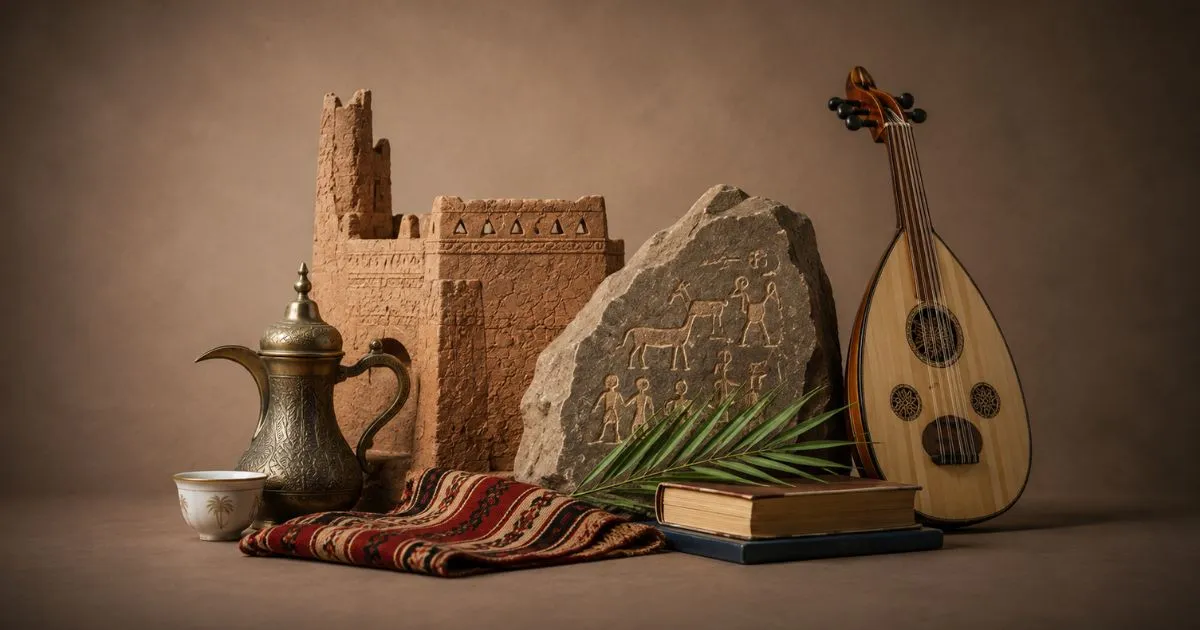
The Saudi Ministry of Culture approves the policies that govern the development and regulation of the cultural sector. Its central task is empowering the cultural scene at home and abroad, with the wider goal of preserving national identity by promoting and protecting visual arts, performing arts, theater, music and literature.
Establishment of the Saudi Ministry of Culture
The ministry was created in 2018 after separating from the Ministry of Media, making it one of the country’s newer ministries. Its minister is appointed by Royal Decree, sits on the Council of Ministers, and chairs the boards of the ministry’s entities.
Headquarters were placed in Historical Diriyah, capital of the first Saudi State, a deliberate signal about the ministry’s relationship with national history. The site’s significance is covered in the guide to the historical components of Diriyah.
Commissions under the Saudi Ministry of Culture
The ministry oversees eleven commissions established alongside it:
- Literature, Publishing and Translation Commission
- Fashion Commission
- Film Commission
- Heritage Commission
- Architecture and Design Commission
- Visual Arts Commission
- Museums Commission
- Theater and Performing Arts Commission
- Libraries Commission
- Music Commission
- Culinary Arts Commission
Vision and roadmap
The ministry launched its vision and roadmap on March 27, 2019, setting the framework for developing the sector. Three objectives sit at its center: promoting culture as a way of life, enabling culture to contribute to economic growth, and creating opportunities for international cultural exchange.
These align with the pillars of Saudi Vision 2030, which cover a vibrant society, a thriving economy and an ambitious nation. In practice the ministry works to integrate Saudi cultural heritage into the daily lives of citizens and residents. Progress across the vision is summarized in the 2024 annual report.
Scholarships, professions and a new university
The first Cultural Scholarship Program in the Kingdom launched in 2019, funding study in cultural and artistic disciplines at leading international universities. In 2020 the Council of Ministers approved the inclusion of more than eighty cultural professions in the new Saudi Unified Occupational Classification, a first in the country’s history that gave cultural and artistic workers formal recognition.
A Royal Order approving the establishment of Riyadh University of Arts was issued on March 14, 2026, following the announcement of its founding on September 29, 2025 during the opening session of the Cultural Investment Conference. The specialized university is headquartered in the Irqah district in Riyadh under the ministry’s supervision, offering programs through approximately thirteen colleges. Full details are in this report on the Riyadh University of Arts launch.
Sectors and identity
The ministry covers about sixteen sub-sectors, including heritage, museums, cultural and archaeological sites, theater and performing arts, festivals and events, books and publishing, architecture and design, natural heritage, films, fashion, language and translation, culinary arts, literature, libraries, visual arts and music.
Its logo draws on national identity, designed as a DNA map using thirteen lines to represent the thirteen regions of the Kingdom, indicating coverage across all of them.
Milestones in Saudi cultural life
The first Cultural Status Report, covering 2019, documented a series of firsts: the Amiri Press established in Makkah Al-Mukarramah in 1882, the play The Oppressor of Himself published in 1932, the al-Masjid al-Nabawi Library founded in 1933, the first Saudi film The Fly produced in 1950, the Jeddah Museum of Antiquities opened in 1961, the first music concert held in Al-Khobar in 1962, and the Antiquities and Museums Department created within the Ministry of Education in 1964.
The report also recorded the first exhibition of school activities in government education in 1953 and the broadcast of the Saudi film Conscience’s Reproach on Saudi television in 1966, directed by Saad Al-Frieh. Fashion education began with embroidery and textile subjects in the Home Economics College curriculum for girls until 1970 and in 1972 the Kingdom signed the UNESCO Convention concerning the Protection of the World Cultural and Natural Heritage. In culinary arts, the Janadriyah Festival launched in 1985 and highlighted traditional cuisine.
Frequently asked questions
When was the Ministry of Culture established?
In 2018, after separating from the Ministry of Media.
Where is it headquartered?
In Historical Diriyah, the capital of the first Saudi State.
How many commissions does it oversee?
Eleven, ranging from the Film Commission to the Culinary Arts Commission.
Related coverage
The ministry’s output is easiest to follow through its individual commissions and their programs. See the national policy for the Arabic language, support for Saudi cinema, UNESCO listed intangible heritage, and the ministry’s digital platform partnership. Official releases appear on the Ministry of Culture website.
