
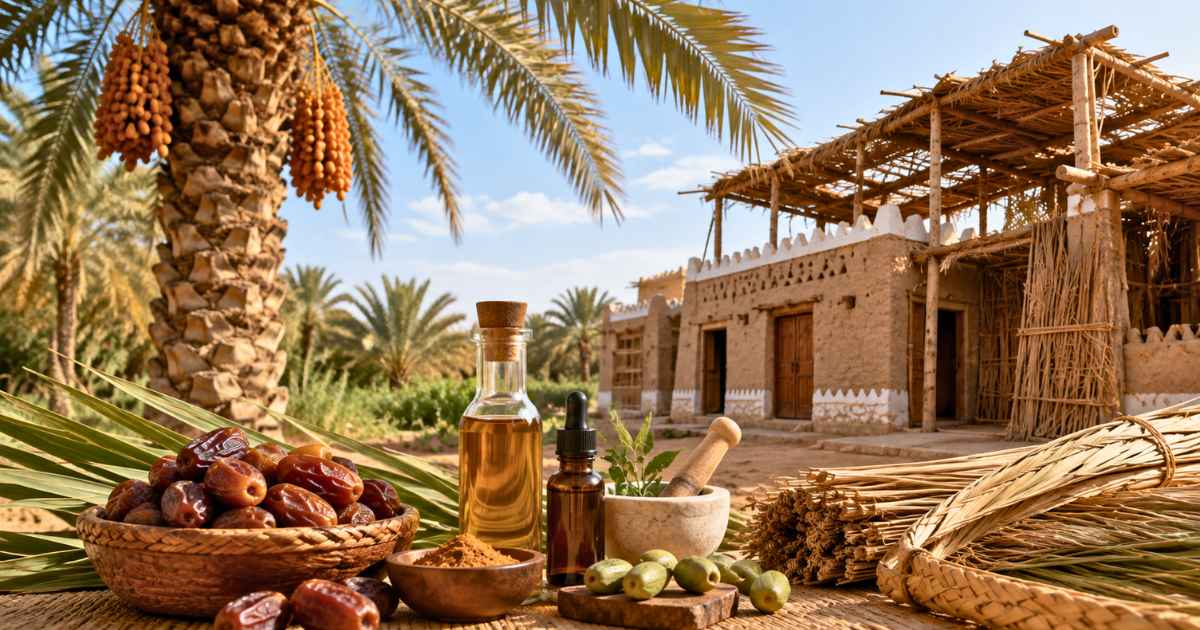
The uses of palm in Saudi Arabia reach far beyond the fruit. Palm feeds people and livestock, supplies material for medicine and oils, burns as fuel, enriches soil as fertilizer and provides building material. Its by-products still feed several manufacturing sectors.
Uses of palm in Saudi Arabia for food
Dates appear on tables at public and private occasions and whenever guests arrive, served with Saudi coffee. Iqt and dates taken with Arabic coffee are known as Qadoo.
Nutritionally, dates are composed of sugar at 74 percent, water at 15 percent, albuminous materials at 2 percent, and fats at 2.5 percent, with vitamins A, B1, and B2, mineral salts and proteins. They keep well and work as food, dessert, and an ingredient in drinks, sweets, and jams, including date infusion.
Traditional dishes include Khabees, made from dates, honey, and butter; al-Ayla, from mashed dates and laban; and al-Hais, also called al-Watba, combining Berni dates, ghee, and pounded Iqt. Related dishes appear in our guide to al-Hesah, and the fruit itself is catalogued in our list of the top types of dates in Saudi Arabia.
Animal feed
Dry dates, low-quality dates, fronds, shees (unfertilized dates), kosba (molasses press residue), and date seed meal are ground into animal feed and fattening supplements. Juicy palm roots and ground fronds go to heavy-working animals.
Medicine and oils
Dates have long been valued as a diuretic and used to support liver cleansing and kidney flushing, mental strength, and nerve fortification. Traditional practice also applies them to softening blood vessels, night blindness, certain eye diseases, and rheumatism, as a uterine astringent after delivery, and in wound healing. Oils extracted from palm trees and fruit are used in pharmaceutical products.
Fuel and fertilizer
Before coal, electricity, and oil, palm served as cooking and heating fuel. Palmwood was burned for charcoal and ash, and the ash was used to clean and whiten metal utensils. It is no longer a primary fuel, though some Bedouin communities without electricity and gas still use it.
For fertilizer, palm residues including fronds, bark, seeds, fibers, and dead or infected trees are burned with animal waste and buried in deep pits called Tabenah to ferment. The result is spread across the soil surface and plowed in as a natural fertilizer that raises fertility.
Construction, crafts and manufacturing
Palm trunks and fronds built shops, house roofs, mosque fences, and structural supports for walls and ceilings. Palmwood was worked into doors, stairs, windows, containers, tables, chairs, and boats cut from trunk sections. Trunks also served as well columns, trough supports known as al-Lazza, and, when split, as gutters called marazim or mazarib carrying rainwater from rooftops or water to farms. That woodworking tradition connects closely to the art of al-Qallafah shipbuilding.
Fronds were used for tying palm sleeves, packaging, and making bins, brooms, fans, mats, baskets, bags, prayer rugs, and hats. Palm fiber went into pillows, ropes, mats, containers, pouches, coffee pot strainers, oil filters, body scrubs, cleaning tools, kindling, waterway protection, vegetable storage, and pollen wrapping. Comparable craft skill appears in al-Sadu weaving.
By-products including dates, date stalks, fronds, fibers, and dry seeds feed industries that rely on cellulose, among them silk production, paper manufacturing, compressed wood, and nylon intermediates. They are also used to dissolve dyes and colorants, and some medical alcohol is extracted from Jumara, the palm heart. Market demand still peaks seasonally, as our report on the start of the dates season shows, alongside broader interest in organic food.
Key takeaways
- Dates are about 74 percent sugar and 15 percent water, with vitamins A, B1, and B2.
- Palm by-products feed livestock, fertilize soil, and supply cellulose industries.
- Tabenah pits turn palm residue and animal waste into natural fertilizer.
- Trunks, fronds, and fiber supplied building material and household goods.
Frequently asked questions related to uses of palm
What are the main uses of palm in Saudi Arabia?
Food, animal feed, medicine and oils, fuel, fertilizer, construction, crafts, and industrial by-products.
Which traditional dishes use dates?
Khabees, made with dates, honey, and butter; al-Ayla, from mashed dates and laban; and al-Hais, also known as al-Watba.
Is palm still used as fuel?
Rarely. It was a primary fuel before coal, electricity, and oil, and some Bedouin communities without utilities still burn it.
What is Tabenah?
A deep pit where palm residues and animal waste are buried to ferment into natural fertilizer.
The bottom line
Little of the palm tree goes to waste, which is exactly why it shaped daily life across the Peninsula for centuries. Historical documentation is held by the King Abdulaziz Public Library.
