
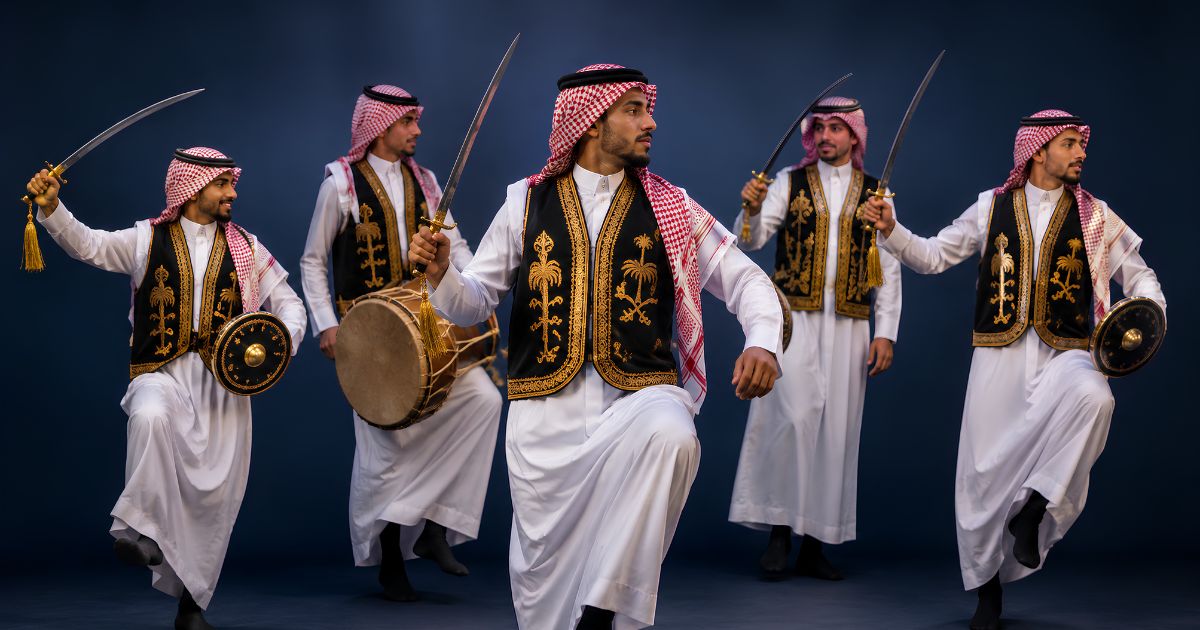
Most traditional Saudi dances trace back to wartime occasions, and they have been treated as heritage that resists reinvention. They are usually called folk dances, and the differences between them come down to formation, rhythm and the role of the voice.
Five stand out across the regions. Each carries a distinct origin and performance style and each remains tied to the area that produced it.
Five traditional Saudi dances and how they differ
The Saudi Ardah
Also known as the Najdi Ardah, this is the country’s signature dance and an official protocol used to welcome visiting foreign heads of state. In 2015 it became the first Saudi element inscribed on the UNESCO Representative List of the Intangible Cultural Heritage of Humanity.
Al-Khutwah
The step dance, also called the Southern or Asiri Khutwah, is the most widespread form in the southern regions. Its name describes the movement: a single step forward, then a move backward, repeated in a steady rhythm within a row of performers.
The Al-Azawi dance in Jazan is closely related, but its steps are shorter and do not extend beyond the standing position, and they come at a higher frequency.
The traditional Northern Dahha
Dahha relies on fierce vocal sounds produced by the performers, signaling readiness for battle and resembling the roar of a lion. Success depends on the strength of the human voice rather than instruments, reflecting older customs of vocal preparation before fighting.
Like other traditional Saudi dances, it uses a row of performers facing a single performer who maneuvers against them. The mishlah, the traditional cloak, is an essential part of the performance.
Al-Fajri
Al-Fajri is among the most famous forms in Al-Ahsa Governorate. Its name derives from al-Hasawi, one of the eight styles of performing al-Fijri. The structure centers on a lead singer supported by a chorus of clappers and singers.
Al-Qazoui
Al-Qazoui involves the widest range of body positions. The performer shifts weight by bending toward the center, returns upright, then jumps after roughly four steps. A correct performance follows a rhythmic pattern of five beats before each new series of steps begins.
Why these forms have been preserved
Because their origins are ceremonial, these dances have not absorbed much innovation, and that resistance is part of their value. They appear at national occasions, heritage markets such as the Wrth Market in Riyadh and across seasonal festivals.
Dress matters as much as movement. The shemagh and ghutra, the egal, the thobe and traditional womens clothing all shape how a performance reads.
Frequently asked questions
Which Saudi dance is used as official protocol?
The Saudi Ardah, also known as the Najdi Ardah, performed when foreign heads of state are welcomed.
What is the difference between Al-Khutwah and Al-Azawi?
Al-Azawi, performed in Jazan, uses shorter steps that stay within the standing position and repeats them more frequently.
Where does Al-Fajri come from?
Al-Ahsa Governorate. Its name derives from al-Hasawi, one of eight styles of performing al-Fijri.
Seeing them performed
These dances are easiest to catch during national celebrations and regional heritage events, where the regional differences are obvious side by side. For related traditions, see the country’s UNESCO listed heritage and the craft of Al-Sadu weaving.
