
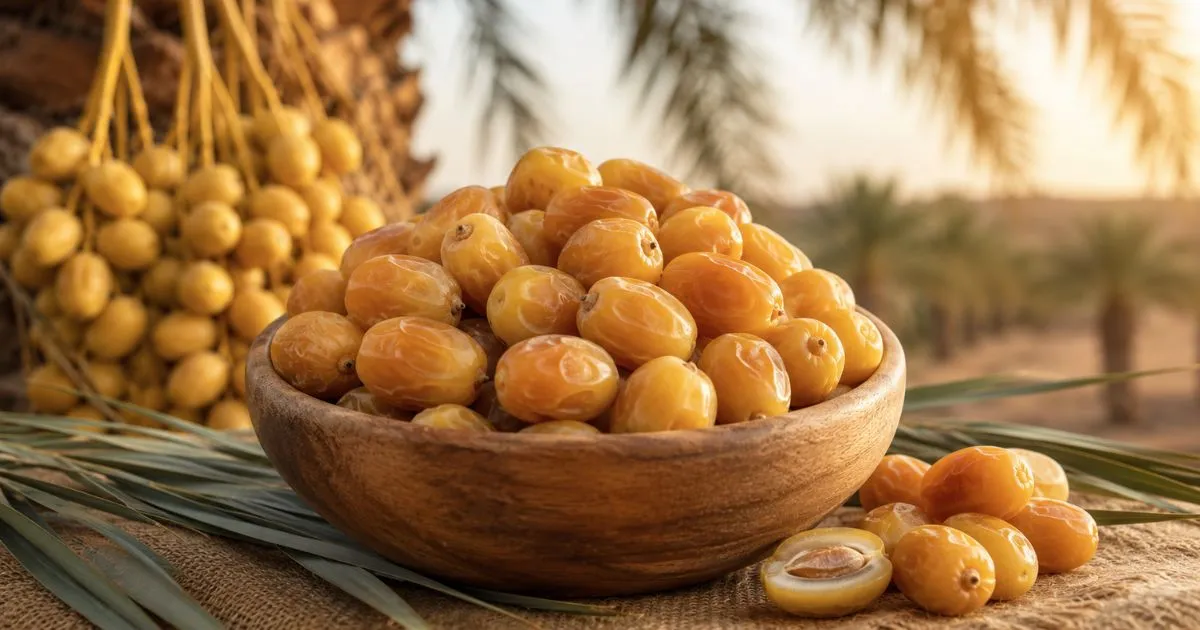
Quick verdict: why Barhi dates stand out
Barhi dates are one of the local date varieties of the Kingdom, though the tree originally came from Iraq and reached the Arabian Peninsula through the people of Unayzah in Qassim Province. They hold a strong reputation in both countries.
Two things drive their price: heavy yield per palm and a texture most people prefer at the crunchy semi-ripe stage rather than fully dried.
Barhi dates at a glance
| Detail | Information |
|---|---|
| Size | Medium |
| Shape | Short, oval, tending to spherical |
| Ripe color | Apricot yellow, amber at Rutab, light brown when fully ripe |
| Annual yield per palm | About 250 kg |
| Grades | Excellent, first, second |
The Barhi dates palm tree
Barhi palms now grow across most regions of the Kingdom. They are large trees with long fronds and sturdy trunks. The fruit is medium sized, slightly thick in texture and usually commands a high price.
The fruit takes a long time to ripen and is eaten semi-ripe, at the Rutab stage, or once dried into a date. If you want the wider picture of local varieties, start with the top types of dates in Saudi Arabia and the seasonal trade covered in the opening of the dates season.
Standards that apply to Barhi dates
Barhi is subject to the guiding quality standards for dates set by the Ministry of Environment, Water and Agriculture. Those standards exist to ease national and international trade, encourage high-quality production, raise returns for producers and exporters, and protect consumers.
Alongside sixteen other varieties in the Kingdom, Barhi must meet agricultural quality standards that apply to producers, traders, importers and exporters. Sector data is published by the National Center for Palms and Dates.
Categories and weights
There are three main categories. In the excellent category the minimum weight of a single date is about seven g, and roughly seventy-one dates weigh five hundred g. In the first category the minimum is six g per date, with no more than eighty-three dates in five hundred g.
The second category is the minimum standard: no less than four g per date, with 125 dates in five hundred g. Buyers who understand these thresholds can judge a box before tasting it.
Sugar profile
Barhi dates are classified as monosaccharide dates, meaning most of their sugar content is glucose and fructose rather than sucrose. That profile is shared with other premium Saudi varieties and is one reason dates travel well in aid shipments such as deliveries to families in Marib.
Beyond the fruit
Palm cultivation supports far more than food. The material side is covered in the uses of palm trees in Saudi Arabia, and date-based products now reach retail shelves through items like Milaf Cola. Growing regions themselves are worth a visit, including the heritage town of Uyun Al-Jiwa in Qassim and the farming areas around Al-Aflaj Governorate.
Final verdict
Buy Barhi at the Rutab stage if you want the flavor it is famous for, and check grade and weight if you are buying in bulk. Yield and grading, not marketing, explain most of the price differences you will see.
