
Quick verdict: what Al-Munifi dates offer
Al-Munifi dates are a local variety first cultivated in Riyadh City, in the central region of the Kingdom. They ripen in late September and rank among the most sought-after varieties in the country.
Scarcity explains much of the demand. A Al-Munifi palm produces no more than seventy kg of dates a year, which is a fraction of what heavy-yield varieties deliver.
Al-Munifi dates at a glance
| Detail | Information |
|---|---|
| Cultivation | Riyadh Province, also Qassim Province |
| Ripening | Late September |
| Annual yield per palm | Up to seventy kg |
| Shape | Elongated oval with a distinct ring |
| Total natural sugar | 59.33 percent |
The palm behind Al-Munifi dates
The fruit comes from a palm carrying the same name. It has been cultivated successfully in Qassim Province as well, though the tree’s yield stays low there too.
Low yield plus late ripening is an awkward commercial combination and it is exactly why the variety trades at a premium rather than in volume. For the market context, see the start of the dates season and the main Saudi date varieties.
How to recognize Al-Munifi dates
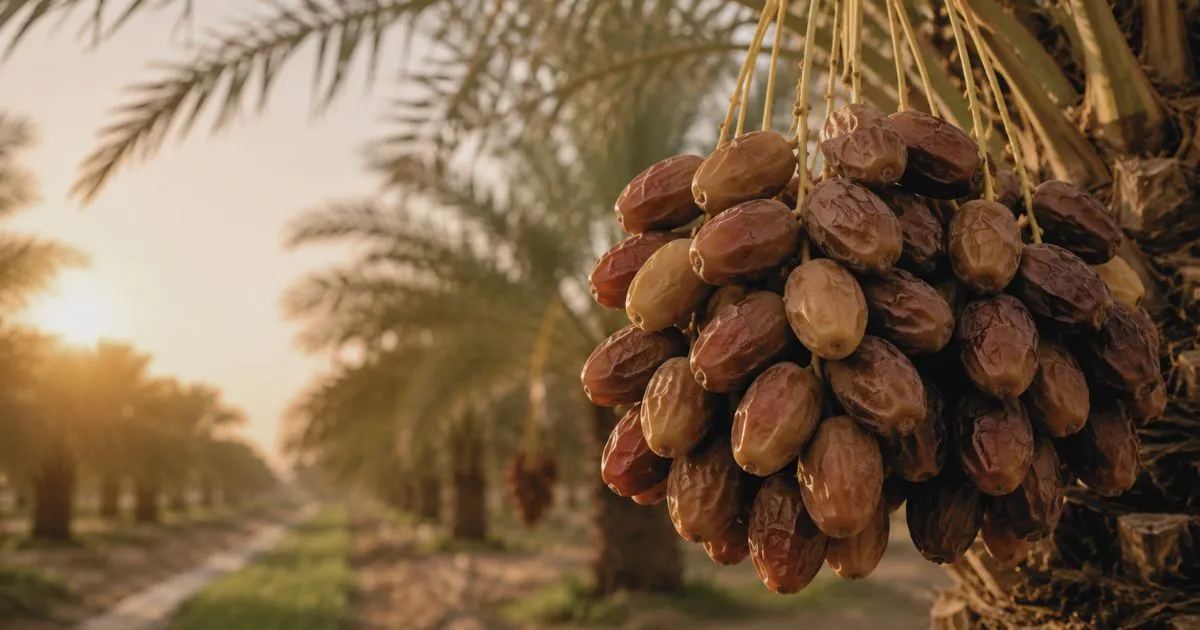
The fruit is an elongated oval. Its primary color is yellow, shifting to apricot brown at the Rutab stage and light brown once fully ripe. A distinct ring marks the fruit, and it holds up well in storage and refrigeration.
Storage tolerance matters for a late-season variety, because it extends the selling window past harvest.
Nutritional content
Al-Munifi dates consist mainly of natural sugars in monosaccharide form. The breakdown is 28.88 percent glucose, 30.42 percent fructose and 0.03 percent sucrose, giving a total natural sugar content of 59.33 percent in a single date.
Monosaccharide dominance means the sugars are absorbed quickly, which is the same property that makes dates a standard fast-breaking food. Research and variety data are maintained by King Abdulaziz City for Science and Technology.
Where the variety fits
Riyadh and Qassim carry much of the Kingdom’s palm cultivation, and the surrounding farming districts are worth knowing, including Al-Aflaj Governorate and Uyun Al-Jiwa in Qassim. Water infrastructure supporting those farms appears in the Qassim water projects.
Beyond the fruit itself, palms feed crafts and materials described in the uses of palm trees in Saudi Arabia, and processed products such as Milaf Cola show where date agriculture is heading commercially. Surplus harvests also support relief shipments like deliveries to Marib.
Final verdict
Buy Al-Munifi for flavor and rarity, not for value per kilo. Late September is the window, the ring on the fruit is the identifier, and refrigeration keeps it usable well past the season.
