
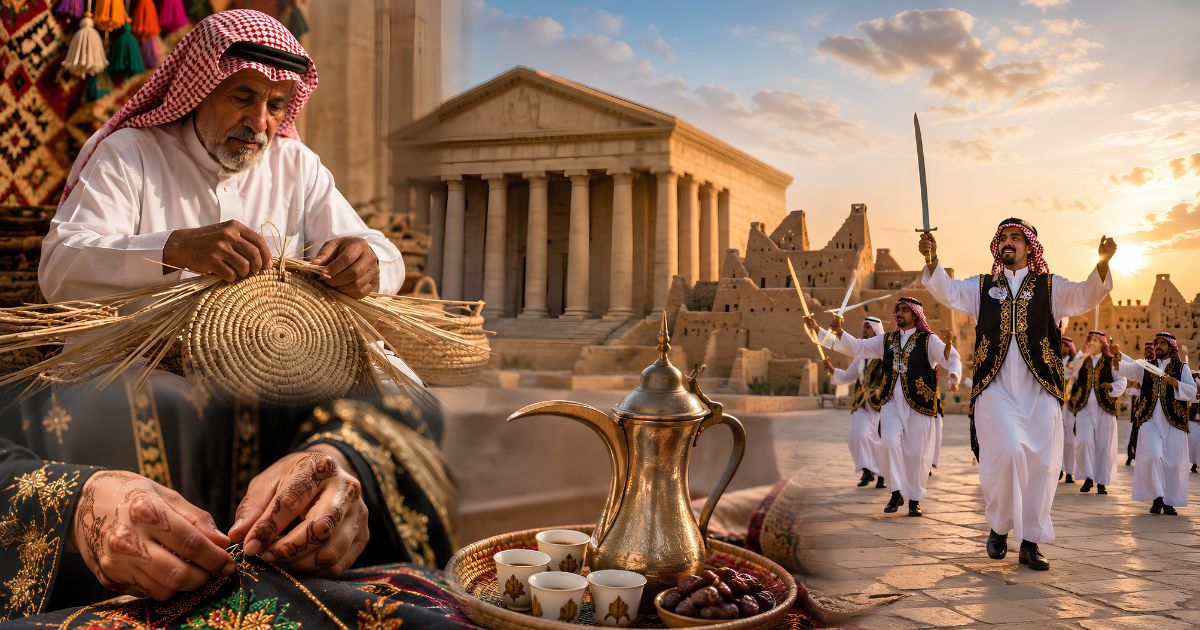
Saudi intangible cultural heritage has a growing presence on the UNESCO Representative List of the Intangible Cultural Heritage of Humanity, with elements inscribed from 2011 onward. The entries range from falconry and Arabic coffee to Taif roses and henna and many were filed jointly with Gulf, Arab and international partners.
What the UNESCO list covers
The Representative List records living practices rather than buildings or sites: skills, oral traditions, performing arts, crafts and social customs that communities pass down. Saudi files have been prepared with the Ministry of Culture and the Heritage Commission, often alongside neighboring states that share the same tradition. The full register is published by UNESCO.
Saudi intangible cultural heritage elements by year
2011 to 2017
- Falconry (al-Bizarah), 2011, inscribed with several Gulf, Arab and international countries. Falconers hunt and train in groups that may stay out for days or weeks, and annual festivals mark the season.
- Al-Ardah Al-Najdiyah, 2015, performed at celebrations, social events and national holidays.
- Arabic coffee, 2015, filed with the United Arab Emirates, Qatar and Oman. In 2022 the Ministry of Culture renamed it Saudi coffee.
- Al-Majlis, 2015, also with the United Arab Emirates, Qatar and Oman. The gathering space is defined by floor carpets, cushions and a coffee stove and by an open door to guests.
- Al-Mezmar, 2016, a group performance from the west of the country in which two rows of men move to drums and clapping while lead performers spin sticks.
- Al-Qatt Al-Asiri, 2017, the hand-drawn geometric wall painting of Aseer Province.
2019 to 2022
- Date palm, 2019, registered with fourteen Arab countries and tied to crafts, livelihoods and social custom.
- Traditional weaving of Al-Sadu, 2020, filed jointly with Kuwait. Its patterns shaped the logo of the G20 Summit hosted by the Kingdom that year.
- Arabic calligraphy, 2021, in a joint file with fifteen other countries.
- Saudi Khawlani coffee, 2022, grown in the southern provinces for close to eight centuries and bound to local poetry, chants and trade.
- Al-Heda’a, 2022, with Oman and the United Arab Emirates, the oral call herders use with camels.
2023 and 2024
- Harees, 2023, with the United Arab Emirates and Oman, covering the know-how and practices behind the dish.
- Engraving on metals, 2023, in gold, silver and copper, in a joint file with nine other countries.
- Taif roses, 2024, the cultivation and social practices of Taif Governorate.
- Henna, 2024, with fifteen other countries, linked in the Kingdom to marriage ceremonies and traditionally practiced by women.
- Semsemiah, 2024, registered with Egypt, a stringed instrument central to coastal communities and their weddings and festivals.
Why these inscriptions matter
Inscription raises the visibility of a practice and commits the country to safeguarding it through documentation, teaching and community support. Several elements now anchor regular public programming, from coffee and date events to craft workshops. Related crafts traditions are covered in our features on Aseer Province handicrafts and the handicrafts of al-Jawf Province.
Food heritage carries a large part of this list, and the date palm entry connects to the varieties described in our guide to types of dates in Saudi Arabia. Public presentation of these traditions has also moved online, as seen in the Ministry of Culture partnership with TikTok.
Key takeaways
- Saudi files on the UNESCO Representative List span 2011 to 2024
- Most were submitted jointly with Gulf, Arab or international partners
- Arabic coffee was officially renamed Saudi coffee in 2022
- Taif roses, henna and semsemiah were the additions in 2024
Frequently asked questions
Which Saudi element was inscribed first?
Falconry, in 2011, in a multinational file.
Is Saudi coffee the same as Arabic coffee?
Yes. The element was inscribed in 2015 as Arabic coffee, and the Ministry of Culture renamed it Saudi coffee in 2022.
How many countries joined the Arabic calligraphy file?
Sixteen in total, the Kingdom plus fifteen other countries, in 2021.
Where is Khawlani coffee grown?
In the southern provinces, where cultivation goes back nearly eight centuries.
The list keeps growing, and each new file gives communities a stronger case for teaching these skills to the next generation. Many of them appear during the events listed in our roundup of festivals and events in Saudi Arabia.
