
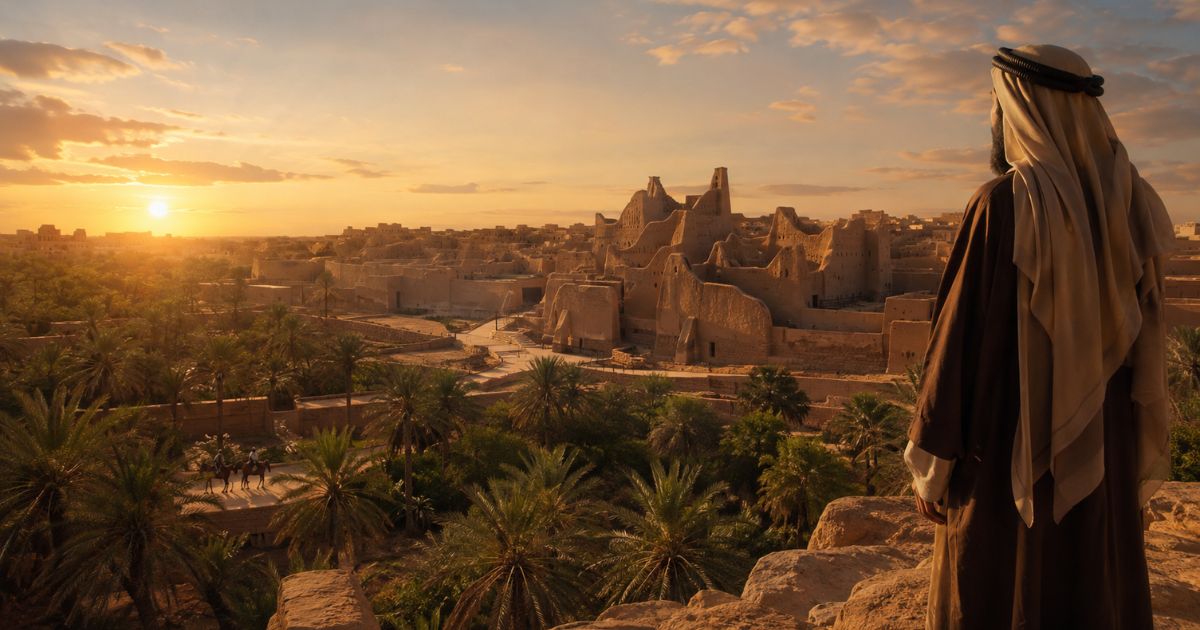
Diriyah Governorate sits northwest of Riyadh on the banks of Wadi Hanifa, carrying more than five centuries of Saudi history. Founded in 1446 by Mani’ Al-Muraydi, it later became the capital of the First Saudi State under Imam Mohammad bin Saud in 1727, and remains the ancestral home of the ruling Al Saud family.
Geography and location
Diriyah lies about 20 kilometers northwest of central Riyadh, at an elevation of roughly 700 meters. It borders the city of Riyadh to the east, Wadi Hanifa and surrounding mountains to the west, Al-Amariyah Road to the north, and the Irqah district to the south. The governorate covers 2,020 square kilometers and has an estimated population of 96,000, according to the Saudi Census 2022.
Historians trace the name Diriyah to the Al-Duru’ clan, led by Mani’ Al-Muraydi. The area was once known as “Al-Awja,” a reference to the winding path of Wadi Hanifa, and the phrase “Ahl Al-Awja” later became closely tied to the Saudi state.
A capital born from history
Archaeological evidence shows human settlement along Wadi Hanifa dating back to the Stone Age. The modern founding of Diriyah began around six centuries ago, when Mani’ Al-Muraydi relocated his family from eastern Arabia, crossing the Al-Dahna Desert to reach Wadi Hanifa. A relative named Ibn Dar’ granted him two areas, Mulaybid and Ghusaybah, which together became Diriyah.
Imam Mohammad bin Saud made Diriyah the capital of the First Saudi State in 1727. Four rulers governed from the city in succession: Imam Mohammad bin Saud, his son Abdulaziz bin Mohammad, then Saud bin Abdulaziz, and finally Abdullah bin Saud. Under their rule, the state’s borders extended from Al-Ahsa to Najd, Al-Hejaz, and Tihamah, eventually reaching Makkah and Al-Madinah.
Al-Turaif District
Al-Turaif District, built in the 18th century, remains one of the largest mud-brick districts in the world and was inscribed on the UNESCO World Heritage List in 2010. It includes Salwa Palace, the seat of government of the First Saudi State from 1766, and the Imam Mohammad bin Saud Mosque, once the state’s largest mosque.
Modern development: the Diriyah Project
King Salman bin Abdulaziz first championed Diriyah’s modern development while serving as Governor of Riyadh, leading to a Royal Decree on October 8, 1998, approving a restoration program. In 2019, the Diriyah Project launched as the fifth megaproject owned by the Public Investment Fund, part of the wider push behind Saudi Vision 2030.
The project’s first phase focuses on Al-Bujairi District, spanning more than seven square kilometers, with five public squares, six museums, five arts academies, and around one hundred restaurants and shops. Saudi Arabia has allocated SAR 240 billion to the project, aiming to house 100,000 residents, welcome 27 million visitors a year, and build 20 international hotels by 2030.
The Diriyah Gate Development Authority, established on July 20, 2017, oversees this urban, economic, social and cultural development across an area of up to 190 square kilometers.
Culture, arts, and tourism
Diriyah hosts more than twenty-six cultural landmarks alongside major international events. Diriyah Season has welcomed the Spanish and Italian Super Cups, the Diriyah Cup between Al Hilal and Newcastle United, the Diriyah Tennis Cup and the historic “Clash on the Dunes” boxing match. The Diriyah Formula E race has run since 2018 and is scheduled to continue through 2028.
JAX District, a former industrial zone reopened in 2021, now hosts around 140 creative units, including galleries and studios, and has staged events such as the Diriyah Contemporary Art Biennale and the JAX Arts Festival. In 2021, ALECSO selected Diriyah as the Arab Capital of Culture for 2030, the second time a Saudi city has received the honor after Riyadh in 2000.
Frequently asked questions
Who founded Diriyah?
Mani’ Al-Muraydi founded Diriyah in 1446.
Why is Diriyah historically significant?
It served as the capital of the First Saudi State from 1727 and remains the ancestral home of the Al Saud royal family.
Is Diriyah a UNESCO World Heritage Site?
Yes, Al-Turaif District in Diriyah was inscribed on the UNESCO World Heritage List in 2010.
Diriyah Governorate is currently led by Prince Rakan bin Salman, who was appointed governor in February 2026. Readers can also explore more of the area’s landmarks in this guide to the historical components of Diriyah.
Official heritage details are published by Visit Saudi and the Ministry of Tourism.
