
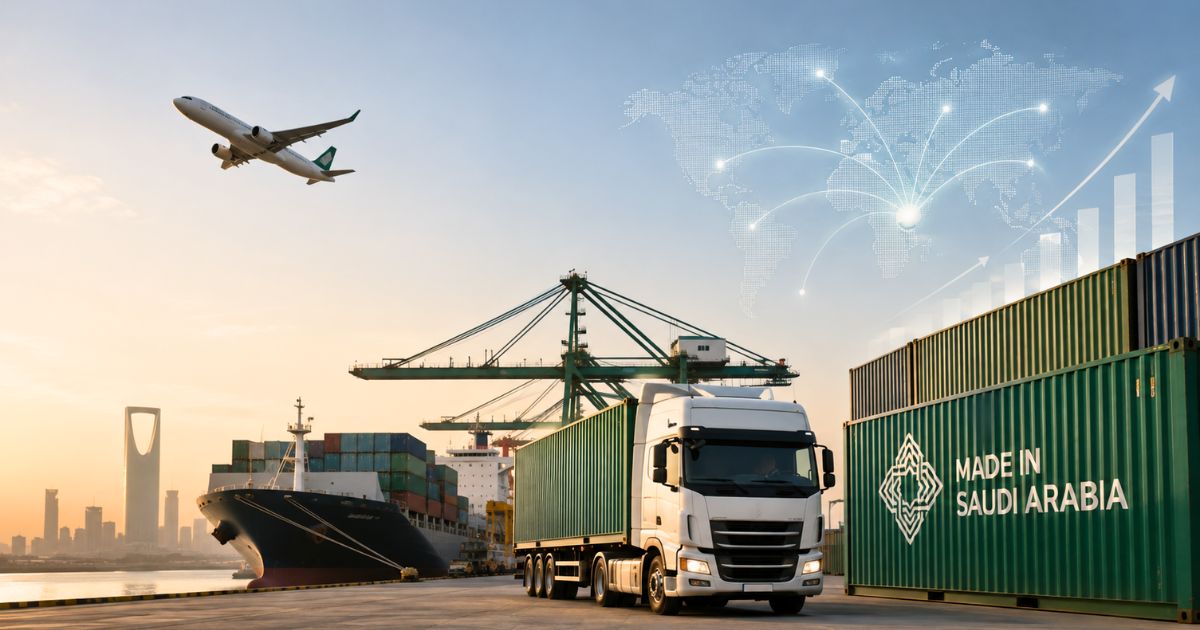
The Saudi Export Development Authority, branded SAUDI EXPORTS, is the government body working to raise non-oil exports, open access to international markets and make the export environment more efficient through programs and incentives for exporters.
How the Saudi Export Development Authority was established
Its origins date to August 20, 2007, when the Council of Ministers approved replacing the Exhibitions and International Markets Directorate and the Export Development Directorate with a single authority. It began operating six years later, in 2013, from headquarters in Riyadh.
The authority holds a legal personality and administrative independence, with an independent annual budget approved under the rules governing the state budget. It is linked organizationally to the Minister of Industry and Mineral Resources, who chairs its board of directors and carries primary responsibility for it. A Secretary-General of no less than the fifteenth rank manages the authority day to day.
Non-oil export performance
Non-oil exports hit their highest recorded value in 2021 at about SAR277 billion, an increase of roughly 36 percent on the previous year. The United Arab Emirates was the leading destination at SAR37.7 billion, followed by China at over SAR36 billion and India at SAR19.1 billion.
Petrochemicals produced the largest share, exceeding SAR164 billion in 2021, up around 48 percent from SAR111.1 billion the year before. The longer trend is tracked in our coverage of non-oil sector growth and the Kingdom’s push on industry and technology.
Market access has widened through trade agreements: the Kingdom joined the World Trade Organization in 2005, signed an agreement to boost inter-Arab trade in 2008, and concluded bilateral agreements with European Free Trade Association members in 2014.
Mandates of the Saudi Export Development Authority
Its functions include preparing studies on export opportunities and target markets, contributing to state policy on non-oil export development, drafting the policies and legislation behind export programs, and preparing plans to promote products and services. It works with public and private sector partners toward six strategic objectives, chiefly linking exporters with buyers and partners, raising the visibility of Saudi products, improving export readiness, and creating suitable export markets for enterprises.
Manufacturers usually encounter the authority alongside platforms such as Senaei and Saber, and through bodies like the Federation of Saudi Chambers and the Jeddah Chamber.
Financing and the incentives program
Financing reaches beneficiaries through the Saudi EXIM Bank, established on February 18, 2020, to provide export finance and guarantee services and credit facilities that keep Saudi exports competitive.
The Saudi Exports Incentives Program offers nine incentives compatible with World Trade Organization requirements:
| Incentive | Compensation | Cap |
|---|---|---|
| Marketing and advertising | 75 percent | SAR200,000 |
| Facilitating visits of potential vendors | 90 percent | SAR50,000 |
| Listing on ecommerce platforms | 70 percent | SAR55,000 |
| Registration of products | 50 percent | SAR55,000 |
| Product certificates | 50 percent | SAR250,000 |
| Individual participation in international exhibitions | 65 percent | SAR150,000 |
| Export strategy and supply chain advisory | 55 percent | SAR255,000 |
| Legal support | 85 percent | SAR100,000 |
Specialized training is compensated at 55 percent under the ninth incentive. Exporters based in the Kingdom’s industrial cities are among the main users of these programs.
Key takeaways
- Approved in 2007, the authority began operating in 2013 from Riyadh.
- It reports to the Minister of Industry and Mineral Resources.
- Non-oil exports reached about SAR277 billion in 2021, up roughly 36 percent.
- Nine incentives are offered, with financing through Saudi EXIM Bank.
Frequently asked questions
What does the Saudi Export Development Authority do?
It develops non-oil exports through studies, policy input, promotion programs, and direct incentives for exporters.
When did it start operating?
In 2013, six years after Council of Ministers approval in August 2007.
Which market bought the most Saudi non-oil exports in 2021?
The United Arab Emirates, at SAR37.7 billion, ahead of China and India.
How is export financing provided?
Through the Saudi EXIM Bank, established on February 18, 2020, which offers export finance, guarantees, and credit facilities.
The bottom line
For any Saudi manufacturer looking abroad, the authority is where the incentive money and the market research both sit. Program terms are published by Saudi Exports.
