
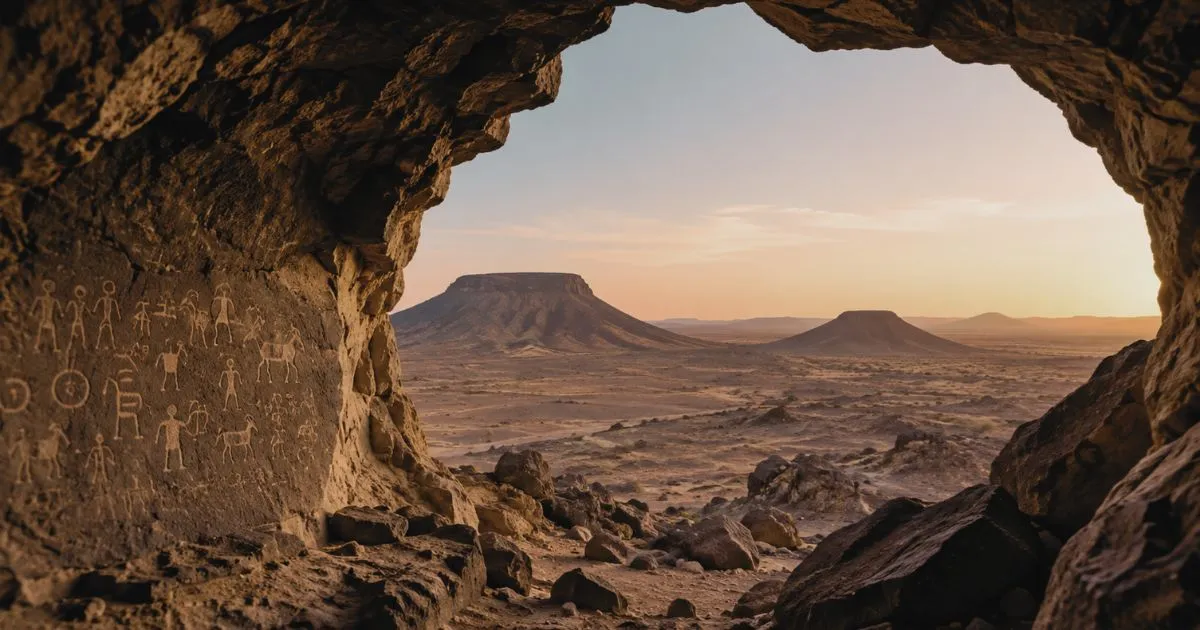
The caves and harrat in Hail Province form one of the most distinctive archaeological landscapes in the northern Kingdom. More than ten caves and twelve volcanic craters have been documented in the province so far, several of them carrying rock art and traces of ancient human activity.
Notable caves and harrat in Hail Province
Two names come up repeatedly: Janin Cave and Sha’afan Cave, both on the edge of Harrat al-Nar. Sha’afan is among the largest caves in the Kingdom, running more than two km in length, with heights reaching eight m and passages descending to depths of eight hundred m underground.
Its side passages wind off to unknown lengths, and scattered skulls and bones have been recorded inside. Other caves comparable in size and archaeological value lie scattered around it. Anyone planning field trips of this kind should also read our guide to climbing locations in Saudi Arabia.
Reading the measurements
Recorded figures for Sha’afan vary between surveys. One measurement puts its underground extent at approximately 1,500 m, with height and width between ten and twelve m, narrowing in places to half a m in height and about 1.5 m in width. The narrow sections are why no survey has traced the passages to their end.
Rock inscriptions at al-Shuwaymis
Al-Shuwaymis lies about 250 km west of Hail City, ringed by mountains on every side, with valleys, ravines and fertile grazing land. Its mountains and caves carry a large body of archaeological inscriptions.
Harrat al-Nar was identified in 2001 by local Bedouins who noticed carvings on the mountain faces. Subsequent study dated the carvings to more than 14,000 years ago. Historical sources describe the area as volcanically active shortly before the mission of the Prophet Muhammad, peace be upon him, and Arab literature records an eruption during the time of the companion Umar Ibn al-Khattab, may Allah be pleased with him.
Access is genuinely difficult. Reaching the site requires a guide from among the local inhabitants, which is standard practice at remote sites across the north, including parts of al-Jawf Province.
Visiting and the wider landscape
Sha’afan Cave is one of the main attractions at al-Shuwaymis and draws visitors interested in archaeology rather than casual sightseers. The province also contains restored settlements such as the heritage town of al-Ghazalah and the region’s craft traditions overlap with the handicrafts of al-Jawf.
Travelers comparing terrain across the Kingdom often pair these sites with the Hejaz Mountains and al-Faqra Mountains, or with the cooler destinations listed in our guide to snowfall places in Saudi Arabia.
Key takeaways
- Over ten caves and twelve volcanic craters have been documented in Hail Province.
- Sha’afan Cave is among the Kingdom’s largest, stretching over two km.
- Harrat al-Nar carvings were identified in 2001 and date back more than 14,000 years.
- Reaching Harrat al-Nar requires a local guide.
Frequently asked questions
How many caves have been found in Hail Province
More than ten caves and twelve volcanic craters have been documented to date.
How old is the rock art at Harrat al-Nar
Studies date the carvings to more than 14,000 years ago.
Where is al-Shuwaymis
About 250 km west of Hail City, surrounded by mountains, valleys, and grazing land.
Can visitors enter Sha’afan Cave freely
It is a known tourist attraction, but the passages narrow sharply and remote sites in the area are reached with local guides.
The bottom line
Hail’s caves and lava fields hold some of the oldest recorded human marks in the north of the Kingdom, and most of them still need a guide to reach. Site records are held by the Heritage Commission.
