
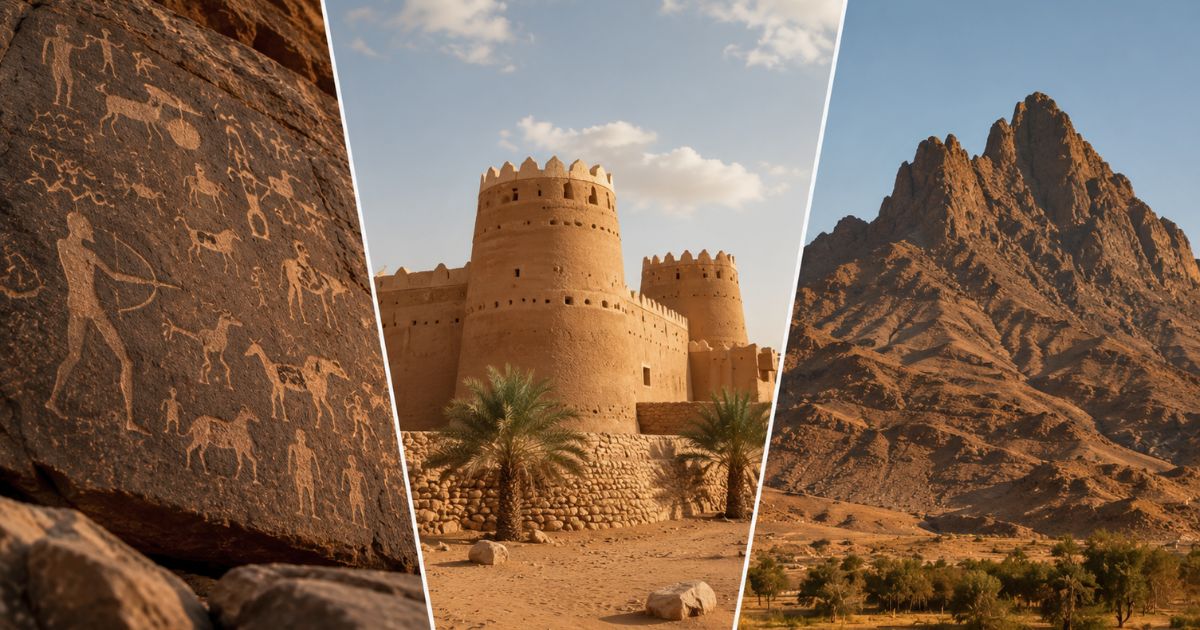
Quick verdict: what the visual icons in Hail Province really are
The visual icons in Hail Province fall into four clear groups and mixing them up is the most common mistake visitors make. Rock art carries the global recognition. Forts and palaces carry the political story. One mosque carries the modern architectural identity. Mountains carry the natural one.
If you only have time for one, go for the rock art. It is the only group on the UNESCO World Heritage List, and it is what put the province on the world map in 2015.
Visual icons in Hail Province at a glance
| Icon group | Example | Why it matters |
|---|---|---|
| Rock drawings | Jubbah, Shuwaymis | World Heritage listing, thousands of inscriptions |
| Forts and palaces | A’arif Fort, Barzan Palace, Qishla Palace | Defense and governance history |
| Architecture | Al-Rajhi Mosque | Modern landmark, 8,800 sq m |
| Nature | Aja and Salma mountains | Granite domes, springs, palm valleys |
Rock drawings: the strongest of the visual icons in Hail Province
Two sites do the heavy lifting here. Jubbah sits on Umm Sinman Mountain and holds rock carvings dating to the Neolithic pottery period. Shuwaymis holds 5,431 inscriptions in Arabic, along with drawings on the Raat and al-Manjour mountains showing human, plant and animal scenes plus other symbols.
Both were inscribed on the World Heritage List in 2015, making them the fourth archaeological site in the Kingdom to earn that status. You can read the official file on the UNESCO listing for the rock art of the Hail region.
Smaller carving sites spread across the province too, including Janin, Mahaja, Jabal Arnan, Jabal al-Asad, Jabal Habran, Jabal al-Misma, al-Ha’it and al-Huwait. They are less visited, but they show how widely the tradition spread. Anyone tracking how the Kingdom protects this material should also look at the work of the Saudi Heritage Commission.
Forts and palaces: the built history
A’arif Fort was built in 1840 on a medium-height mountain to guard the city from the south. It reads as a watchpoint first and a monument second, which is exactly why it survives in the local imagination.
Barzan Palace, built of mud, remains one of the most famous buildings in the city. Qishla Palace came much later, in the early 1960s, and gathers the architectural elements typical of central Saudi building traditions in one place.
If you like this kind of mud architecture, the same logic shows up in the Ad-Dilam wall in Riyadh and in the historical castles around Riyadh.
How the built icons compare
A’arif Fort wins on setting. Barzan Palace wins on fame. Qishla Palace wins on architectural completeness. There is no single best answer, and locals will argue about it happily.
Architecture and nature
Al-Rajhi Mosque, completed in 2006 across a total area of 8,800 sq m, is the modern entry on the list. Its design is deliberately distinctive, which is why it functions as a visual shorthand for the province today.
On the natural side, the Aja and Salma mountains sit close to each other and carry a large number of granite domes and standing columns. Their valleys hold seasonal and permanent springs, along with plenty of acacia and palm trees. Travelers who enjoy that terrain often pair the trip with the Hejaz mountains or the al-Faqra mountains.
Planning a visit
Hail rewards a two-part trip: one day for rock art, one day for the city core. Add the heritage town of Al-Ghazalah if you want a village-scale view of the same building traditions, and the caves and harrat of Hail Province if geology interests you more than architecture.
Final verdict
Rock art first, forts second, mountains third and the mosque as the modern bookend. That order matches both historical weight and visitor payoff. Anyone building a wider Saudi heritage itinerary can slot Hail between Riyadh and the north without losing a theme.
