
Al-Jawf Province is one of the thirteen administrative regions of Saudi Arabia, sitting in the far north of the country. It ranks ninth among provinces by surface area and fourth lowest by population. Its northern border meets the Hashemite Kingdom of Jordan, with the Northern Borders Province to the east, Tabuk Province to the west, and Hail Province to the south.
The city of Sakaka is the administrative capital, the seat of the emirate, and the main urban center. Unlike most provinces, no governorate inside Al-Jawf carries the province’s name. Al-Jawf refers to the whole geographical area, which covers Sakaka, the three governorates of Al-Qurayyat, Tabarjal and Dawmat Al-Jandal and thirty-three local centers.
Area and population of Al-Jawf Province
The province covers 85,000 square kilometers, equal to 4.3 percent of the Kingdom’s territory. Its population stands at 595,822 according to the 2022 Saudi Census, which is 1.85 percent of the national total and places it tenth by population.
Sakaka alone holds 39.7 percent of the province’s residents. Saudis make up about 67.7 percent of the total. Population density works out at 5.8 people per square kilometer, ninth among Saudi provinces.
Leadership and access to Al-Jawf Province
Prince Faisal Bin Nawaf Bin Abdulaziz Al Saud has served as governor since 2018. On December 12, 2023, a Royal Order appointed Prince Miteb Bin Mishal Bin Badr Bin Saud Bin Abdulaziz as deputy governor with excellent rank.
Air access runs through Al-Jawf Regional Airport in Sakaka and Al-Qurayyat Domestic Airport in the north. Turaif and Arar domestic airports sit outside the province but are both around a two-hour drive away, and are served by the national carriers operating in the Kingdom.
Renewable energy hub of the north
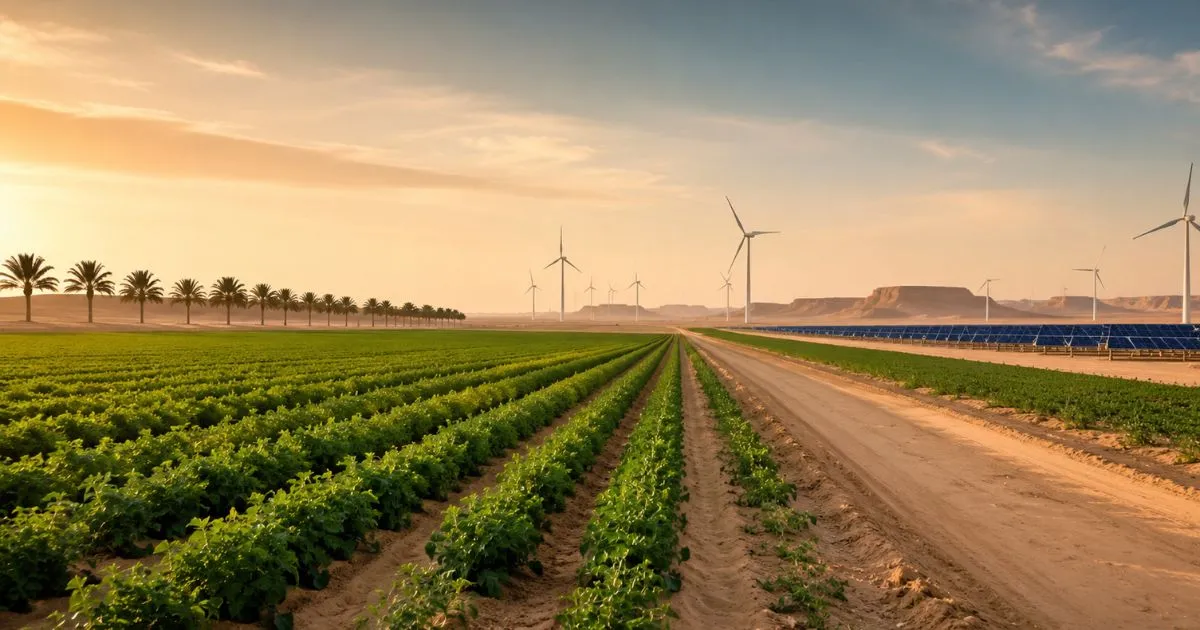
Al-Jawf functions as the Kingdom’s renewable energy hub and a pillar of the shift away from oil dependence. In Dawmat Al-Jandal Governorate, the largest wind farm in the Middle East generates four hundred MW of green power.
The Sakaka Solar Power Plant adds three hundred MW of solar photovoltaic capacity from a site spanning six square kilometers in the administrative capital. Together they anchor the province’s role in national energy diversification, a theme that runs through Vision 2030 reporting.
Agriculture and food security
The province is often described as a diversified food basket. It contains the world’s largest modern olive farm and contributes an estimated 16.55 percent of the Kingdom’s total vegetable production.
Around 3,500 agricultural projects and 12,500 farms operate here, the highest agricultural output of any Saudi province. Irrigation methods are deliberately water conscious, including drip irrigation linked to a computerized system that delivers water volumes based on sensor readings from the fields. The approach mirrors national work on water resources and dams.
Heritage and landscape
Al-Jawf holds sites documenting early human settlement and the early Islamic period, including archaeological inscriptions in Sakaka, Zaabal Castle, Mowaisen Castle, Marid Castle, Kaf Palace and Omar Ibn Al-Khattab Mosque. The province was a stop on a continental route linking the Kingdom and the Gulf with its northern neighbors.
The name itself comes from the land. Al-Jawf sits low relative to other provinces, and the old term carries the sense of a hollow or doline. Fifty km north of Sakaka lies Dawmat Al-Jandal Lake, the largest lake in the Kingdom, whose shores host festivals and celebrations. Local craft traditions are covered in more depth in handicrafts of Al-Jawf Province and at the Al-Jawf Museum.
Climate
A desert continental climate prevails, cold in winter and hot and dry in summer. Summer averages sit near thirty degrees Celsius with peaks up to forty-two. Winter averages 8.5 degrees Celsius, but January can fall to between two and seven degrees below zero, with cold spells that sometimes reach freezing. Travelers chasing the cold season often pair the north with winter tourism destinations elsewhere in the Kingdom.
Frequently asked questions
What is the capital of Al-Jawf Province?
Sakaka, which is also the seat of the emirate and home to Jouf University.
How many governorates does Al-Jawf have?
Three: Al-Qurayyat, Tabarjal and Dawmat Al-Jandal, plus thirty-three local centers.
What is the largest lake in Saudi Arabia?
Dawmat Al-Jandal Lake, located fifty km north of Sakaka in Al-Jawf Province.
Why the province matters
Few regions combine clean power, food production and deep archaeology as directly as this one. For readers tracking regional profiles, comparable guides cover Khamis Mushait Governorate and Ras Tanura Governorate.
Stay updated
Follow us for latest Guides:
✅ WhatsApp Channel
☑️ Telegram Channel
