
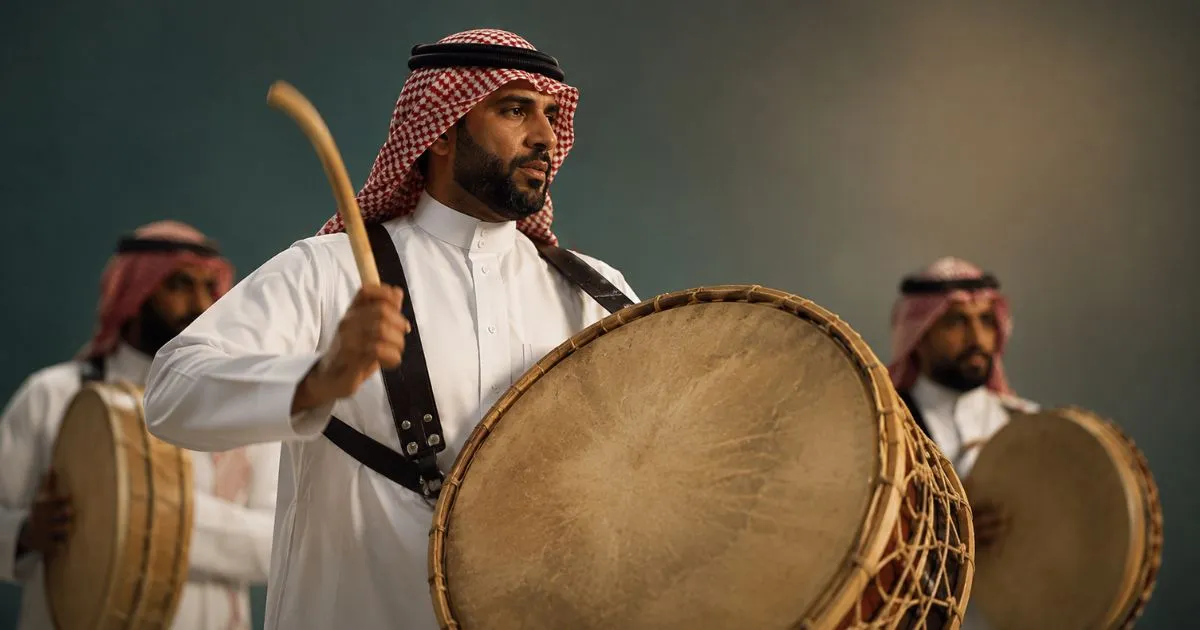
Saudi Ardah rhythms are the engine of one of the country’s best known performing arts. The drumming is not background sound. It sets the tempo, shapes the poetry, and tells every performer in the row when to step, when to hold and when to raise the voice. Listen closely and the pattern is far more layered than it first appears.
The Ardah itself is a vocal and movement art built on verse, and its beat structure carries the meaning of that verse. The Najdi Ardah was inscribed in 2015 as the first Saudi element on the UNESCO Representative List of the Intangible Cultural Heritage of Humanity and it sits alongside the country’s wider recognized intangible cultural heritage.
How Saudi Ardah rhythms are structured
Two drum families do the work. Big drums produce a single stroke known as Tafreda. Small drums produce two strokes, known as Muthaniyah. Because the small drums supply two of the three strokes that complete the cycle with the big drum, they are called Tathlith drums.
The whole art rests on a basic rhythmic composition built on a binary unit frequency. The strongest strokes come from the Dum beat, played in the middle of the drumhead with a bamboo stick. The Tek beat is played in the same spot, but the stick mutes the parchment so the tone is dry and short.
The role of Takhmir drums in Saudi Ardah rhythms
Big drums are called Takhmir drums because they carry the key rhythmic composition. That core pattern is repeated roughly eighty times or more across a performance, which gives the row of performers a steady frame to move against.
After the Takhmir drums have laid down a few repetitions, the Tathlith drums enter with the accompanying figure. The two lines run against each other and create a counter melody. Neither line is decorative. Both carry equal weight in the finished sound.
Why the term Tathlith is used
Two explanations sit behind the name. One points to the performer dividing the 6/8 unit internally into three, a habit that shows genuine musical instinct rather than formal training. The other points to the intent of playing three strokes, with each group containing a Tek beat. Both readings describe the same practical result.
Movement, voice and the shared pulse
Drumming is only half the picture. The strokes are matched by the steps of the performers, who lock breath, rhyme and movement into a single pulse. The Swiss musician Jaques-Dalcroze studied this relationship between bodily movement and sound in his work on eurhythmics, and the Ardah is a living example of it.
That physical coordination is why the Ardah reads as ceremony rather than entertainment. It is used as official protocol when foreign heads of state are received, and it appears at national occasions such as Flag Day and across the country’s festivals and public events.
Key takeaways
- Big Takhmir drums carry the core rhythmic composition, repeated around eighty times or more.
- Small Tathlith drums add the counter figure that completes the cycle.
- Dum is the strong open stroke; Tek is the muted stroke played in the same spot.
- Steps, poetry and drumming are locked to one shared pulse.
Frequently asked questions
What instruments produce Saudi Ardah rhythms?
Only drums. Big drums, called Takhmir drums, and small drums, called Tathlith drums, both played with a bamboo stick.
What is the difference between the Dum and Tek beats?
Dum is struck in the middle of the drumhead and produces the strongest tone. Tek is struck in the same place, but the stick mutes the parchment so the sound is shorter.
Is the Ardah recognized internationally?
Yes. The Najdi Ardah was added to the UNESCO Representative List of the Intangible Cultural Heritage of Humanity in 2015, the first Saudi element to be listed.
Where to hear it
Ardah performances turn up at national celebrations, heritage seasons and official receptions and the drumming is often the first thing visitors notice. If you are exploring the country’s living arts more widely, the same cultural thread runs through Al-Sadu weaving, traditional headwear, the egal head ring, and the long history of the Kingdom that shaped all of them.
