
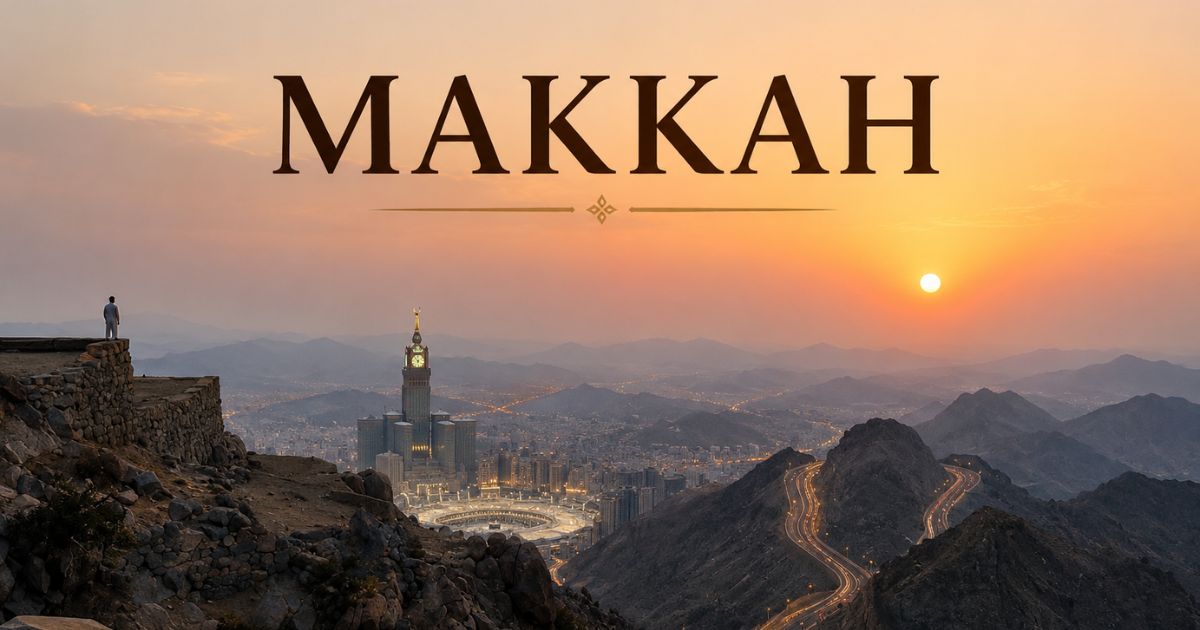
Makkah al-Mukarramah Province is one of the thirteen administrative provinces of Saudi Arabia and the fourth largest by area. It holds the Grand Mosque and the holy sites and it also carries a heavy share of the national economy through Jeddah, King Abdullah Port and a steady flow of pilgrims. This guide sets out its administration, population, geography, landmarks and climate.
Where Makkah al-Mukarramah Province sits
The province borders Riyadh Province to the east, al-Madinah al-Munawwarah Province to the north, Aseer and al-Bahah Provinces to the south and the Red Sea to the west. Makkah al-Mukarramah City is the administrative capital and the seat of the emirate.
For thirty-four years after the Kingdom was founded, the province was administered by King Faisal Bin Abdulaziz Al Saud, first as deputy to King Abdulaziz Bin Abdulrahman Al Saud and later as Crown Prince under King Saud. Prince Khalid al-Faisal has served as governor since 2015. A royal order issued on December 12, 2023 appointed Prince Saud Bin Mishaal Bin Abdulaziz as deputy governor with excellent rank.
Governorates and administrative structure
Sixteen governorates and 128 centers make up the province, among them Jeddah, Taif, al-Qunfudhah, al-Lith, Rabigh, al-Jumum and Khulays. Makkah al-Mukarramah City has expanded steadily while keeping its oldest boundary markers, the al-Haram boundaries, defined by 1,104 landmarks in the four directions around the city.
Holy sites and pilgrim numbers
The province contains the sites where Hajj and Umrah rituals are performed, and its capital is the religious center for Muslims worldwide. The Muslim World League and the Organization of Islamic Cooperation are both headquartered there. In 2023 the city received about 13.5 million visitors, and the number of Hajj pilgrims that year reached about 1,845,045. Visitors planning a trip often start with our guide to ziyarat places in Makkah.
Population and area
According to the 2022 Saudi Census published by the General Authority for Statistics, the province is second only to Riyadh in population, with 8,021,463 residents, or 24.9 percent of the national total. Its area is about 137,000 km2, roughly 7 percent of the Kingdom, and population density averages about fifty-eight people per km2.
- Makkah al-Mukarramah City: 2,427,924 residents, 42.7 percent of the province
- Jeddah Governorate: 3,751,722 residents, 46.7 percent of the province
- Rank by area nationally: fourth, after the Eastern Province, Riyadh and al-Madinah al-Munawwarah
Jeddah is the second most populous city in the Kingdom after Riyadh. Postal coverage for both cities is listed in our Makkah and Jeddah postal codes list.
Economic weight
King Abdullah Economic City, established in 2005 in Rabigh Governorate, covers 181 km2 and includes King Abdullah Port, which ranked among the world’s fastest growing ports in 2018 in the Alphaliner ranking and leads the province in container handling growth.
The province contributes 13 percent of national GDP and holds 22 percent of the economically active population, second to Riyadh. It also hosts 28 percent of family businesses, a segment that employs about 7.2 million people, or 52 percent of the Kingdom’s workforce. Large development schemes continue to reshape the area, including the King Salman Gate project in Makkah.
Landmarks and heritage
Historic Jeddah, inscribed on the UNESCO World Heritage List, keeps the layout and character of its old neighborhoods while modern infrastructure grows around it. Taif Governorate, in the center of the province, is the Kingdom’s best known summer destination and the home of Souk Okaz, a cultural gathering that traces back to around the year 500. Taif is also a center for horse breeding, as covered in our overview of Arabian horses in Taif.
Water, agriculture and transport
Although the province lies within the Arabian-Nubian Shield formation, which lacks deep groundwater, its surface water is renewable. About fifty-seven dams hold up to eighty-six million m3 and agricultural holdings numbered around 61,000 as of 2019.
King Abdulaziz International Airport in Jeddah is the main air gateway for pilgrims, while Taif International Airport serves the eastern side of the province. On September 25, 2018, King Salman Bin Abdulaziz Al Saud inaugurated the Haramain High-Speed Railway, linking Makkah al-Mukarramah, King Abdulaziz International Airport, King Abdullah Economic City and al-Madinah al-Munawwarah.
Climate
The climate alternates between Mediterranean and monsoon influences. Tropical fronts reach the province in summer, and the average annual temperature is about thirty-one degrees. Humidity averages around 46 percent. Rainfall is lowest in Jeddah Governorate and highest in Taif Governorate.
Key takeaways
- Second most populous province with 8,021,463 residents
- Sixteen governorates and 128 centers, capital at Makkah al-Mukarramah City
- 13 percent of national GDP, anchored by Jeddah and King Abdullah Port
- Home to the Grand Mosque, Historic Jeddah and Souk Okaz
Development across the province continues under the targets described in the Vision 2030 annual report, with pilgrim services and logistics the two clearest growth areas.
