
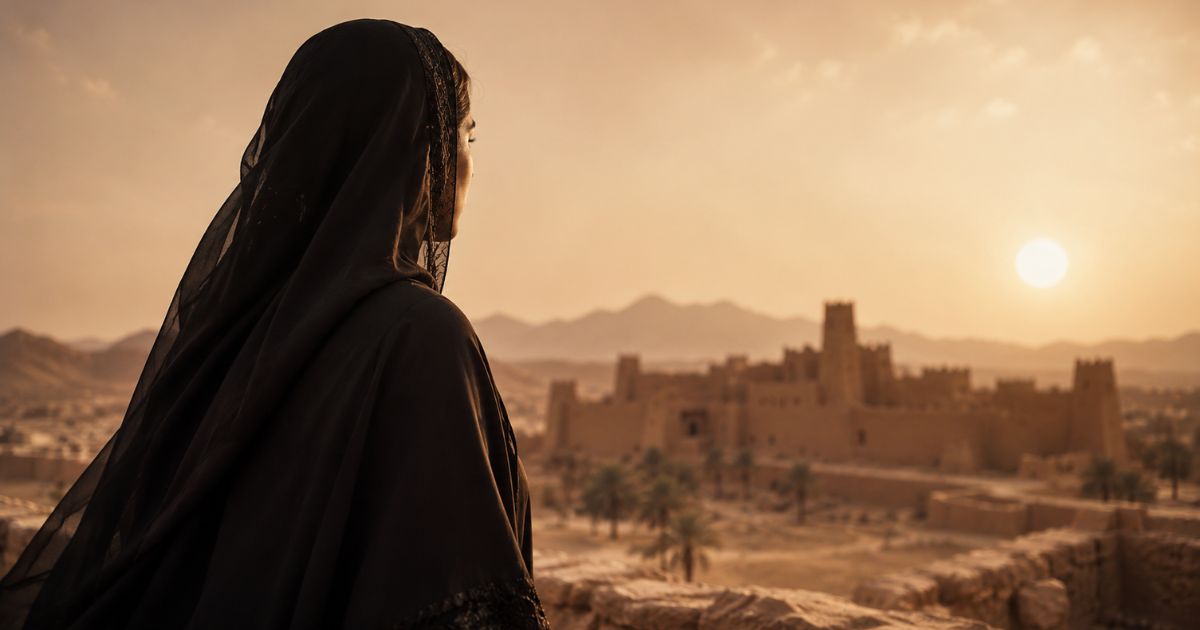
Princess Nourah bint Abdulrahman Al Saud stands among the most consequential women in the story of modern Saudi Arabia, and her influence reached far beyond the walls of her Riyadh palace. Born in 1875, she was the elder sister of the Kingdom’s founder, King Abdulaziz bin Abdulrahman Al Saud, and she acted as first lady throughout his reign. Her name still travels with the country today, carried by the largest women’s university in the Kingdom.
Who Princess Nourah bint Abdulrahman Was
Her full name was Nourah bint Abdulrahman bin Faisal bin Turki bin Abdullah bin Mohammed bin Saud, and she lived from 1875 to 1949. Her mother, Princess Sarah bint Ahmed bin Mohammed al-Sudairi, was one of the best known women of her generation, remembered for her judgment and force of personality.
Contemporary accounts describe Nourah as devout, patient and quietly commanding. She managed households and family affairs with a steady hand, kept close to ordinary people and made a habit of helping those who had nowhere else to turn.
Her Role in the Recapture of Riyadh
The recovery of Riyadh was the turning point that made the modern Saudi state possible, and Nourah was one of the voices that pushed her brother forward. She encouraged him to press on with the campaign to restore Saudi rule, and family tradition holds that her conviction strengthened his own at moments when the outcome looked uncertain.
That support was not symbolic. It helped set the tone for a leadership style in which counsel from within the family carried real weight, a pattern that later shaped how Riyadh grew into the Saudi capital and how the state organized itself around the city.
Daily Life Inside Her Riyadh Palace
Women travelled to Nourah’s palace to learn, to ask questions and to raise their needs. She listened, and she carried those requests directly to King Abdulaziz, who responded to matters affecting women through her. In practice she operated as a channel between the ruler and a section of society that had few other formal routes to him.
She was equally attentive to children, encouraging their schooling and supporting their families. Visitors and female guests were received with ceremony, and hospitality at her palace became part of her reputation.
She married Prince Saud bin Abdulaziz bin Saud bin Faisal and settled at al-Shamsiya Farm in Riyadh, where a palace was built for her. The neighbourhoods and landmarks of that era, from Masmak Fort to the surviving heritage villages around Riyadh, still frame the world she lived in.
Why the Royal Family Was Called “Brothers of Nourah”
King Abdulaziz was openly proud of his sister. He would announce, “I am the brother of Nourah,” and “I am the brother of al-Anwar.” The phrase spread through the royal family, whose members came to be nicknamed the brothers of Nourah. It was an unusual public marker of a woman’s standing inside the young Saudi state, and it has been read ever since as an early signal of the respect accorded to Saudi women at the highest level.
Her Standing in Saudi Memory
Nourah is remembered as a model of the Saudi woman who works for her community. Her charitable and social activity left a durable mark, and her relationship with the king was unusually close. He visited her daily and consulted her on most family and community questions, and she interceded with him on behalf of people in need.
Her legacy is institutional as well as personal. Princess Nourah bint Abdulrahman University, the first and largest women’s university in the Kingdom, carries her name, and its new university city was inaugurated in Riyadh in 2011 across an area of more than eight million square metres. That scale places it alongside the Kingdom’s other landmark education projects, including the new University of Arts in Riyadh and the Islamic University.
Her example is also invoked when Saudi women take senior public roles abroad, from Princess Reema bint Bandar to Princess Haifa al-Mogrin.
The Restoration of al-Shamsiya Palace
On September 11, 2019, Crown Prince and Prime Minister Mohammed bin Salman bin Abdulaziz directed the renovation of Princess Nourah’s historic palace, al-Shamsiya, near the al-Murabba neighbourhood in Riyadh. The founding king had ordered its construction in 1935 for Prince Saud bin Abdulaziz bin Saud bin Faisal and for his sister Nourah.
The project belongs to a wider push to conserve early Saudi architecture, alongside sites such as the historical palace of King Abdulaziz and the conservation work overseen by the Heritage Commission.
Death and Lasting Influence
Princess Nourah died in 1949 at the age of seventy-seven. What survives is not only a name on a university gate. It is a record of a woman who advised a founder, advocated for women and children, and helped set the expectation that Saudi women would be present in the country’s public life.
Key Takeaways
- Princess Nourah bint Abdulrahman lived from 1875 to 1949 and served as first lady during King Abdulaziz’s reign.
- She encouraged her brother’s campaign to restore Saudi rule in Riyadh.
- Her palace functioned as a place where women could learn and bring forward their needs.
- The king’s phrase “I am the brother of Nourah” gave the royal family a lasting nickname.
- Her name is carried by Princess Nourah bint Abdulrahman University, whose Riyadh campus opened in 2011.
FAQs About Princess Nourah bint Abdulrahman
Who was Princess Nourah bint Abdulrahman?
She was the elder sister of King Abdulaziz, the founder of Saudi Arabia, and she acted as first lady during his reign from her base in Riyadh.
Why is the Saudi royal family called the brothers of Nourah?
Because King Abdulaziz proudly used the phrase “I am the brother of Nourah,” which spread among family members as a mark of her standing.
Which university is named after her?
Princess Nourah bint Abdulrahman University in Riyadh, the first and largest women’s university in the Kingdom, with a university city inaugurated in 2011.
When did Princess Nourah die?
She died in 1949 at the age of seventy-seven.
Her story is now part of how the Kingdom talks about its own founding, and the restoration of al-Shamsiya keeps that history physically present in Riyadh. Readers who follow Saudi heritage coverage can track further updates through the Ministry of Culture and on the KsaPoint WhatsApp channel.
