
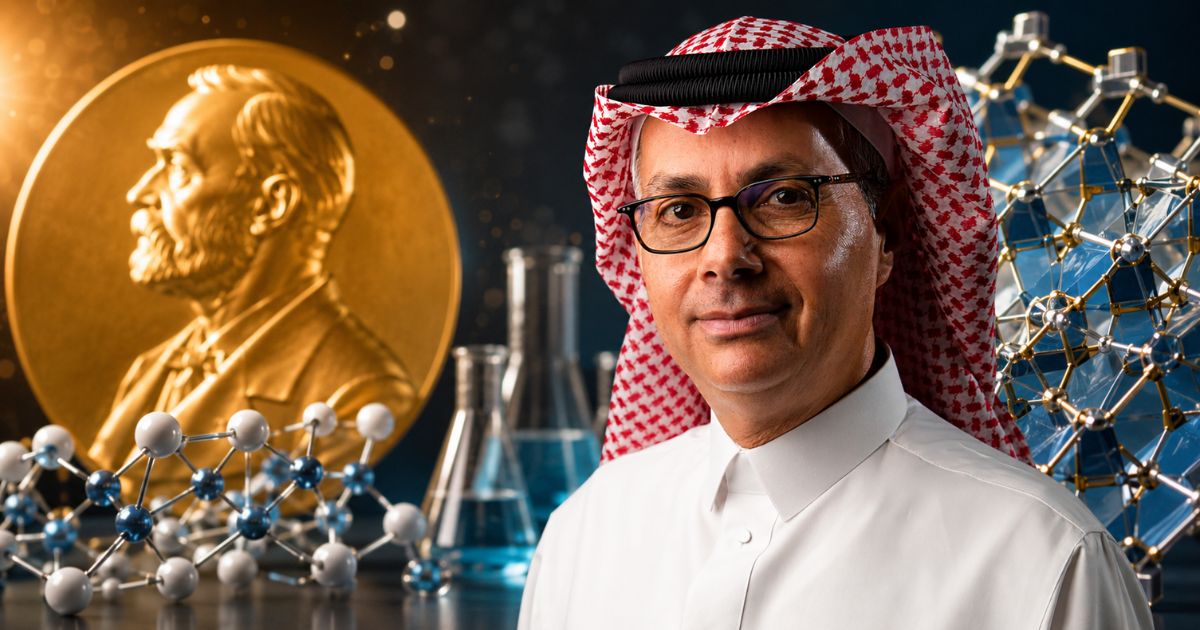
Omar Yaghi is a Saudi professor and scientist who founded the field of reticular chemistry and, on October 8, 2025, became the first Saudi to win the Nobel Prize in Chemistry, awarded by the Royal Swedish Academy of Sciences. His full name is Omar Moenes Yaghi, and his work on framework materials has reshaped how chemists design solids atom by atom.
Education and early career of Omar Yaghi
He moved to the United States at fifteen to continue his studies, starting at Hudson Valley Community College and then completing a bachelor’s degree at the State University of New York in Albany. He went on to the University of Illinois at Urbana-Champaign, where he earned a PhD in chemistry. In 1990 he received a two-year postdoctoral fellowship from the National Science Foundation at Harvard University.
His teaching career took him to Arizona State University from 1992 to 1998, the University of Michigan from 1999 to 2006, and the University of California, Los Angeles from 2007 to 2012. In 2012 he became the first holder of the James and Neeltje Tretter Chair of Chemistry and Biochemistry at the University of California, Berkeley and co-director of the Cal Institute for Nanoscale Science at Berkeley and Lawrence Berkeley National Laboratory.
Scientific achievements
Yaghi developed new ways to build materials and put them to work, including incorporating biomolecules and capturing gases such as carbon dioxide and hydrogen. Out of six thousand chemists surveyed, he was ranked the second most-cited chemist for work published between 1998 and 2008. He has published close to two hundred papers, cited by other researchers roughly sixty thousand times.
Awards won by Omar Yaghi
- Exxon Award, American Chemical Society, 1998
- Sacconi Medal, Italian Chemical Society, 2004
- Newcomb Cleveland Prize, American Association for the Advancement of Science, 2007
- United States Department of Energy Hydrogen Programme prize, 2007
- American Chemical Society Award, 2009
- King Faisal Prize in Science, 2015
- Wolf Prize in Chemistry, 2018
- Arab Geniuses Award in Natural Sciences, 2024
- Nobel Prize in Chemistry, 2025
He was ranked among the ten smartest scientists and engineers in America in 2006, and he is the sole recipient of the Materials Research Society Medal for theorising, designing, building and applying metal-organic frameworks with nanoporous cavities.
Why the Nobel citation matters
The 2025 award recognised his role in founding reticular chemistry and developing metal-organic frameworks and covalent organic frameworks. Those materials changed materials science and opened applications in clean energy, water harvesting, and environmental protection, fields that align closely with Saudi Arabia’s industrial and technology priorities. Saudi scientific recognition has been building for years, as the career of physicist Reem Al-Tuwairqi also shows.
Key takeaways
- First Saudi scientist to receive the Nobel Prize in Chemistry.
- Founder of reticular chemistry and a pioneer of metal-organic frameworks.
- Winner of the King Faisal Prize in Science in 2015 and the Wolf Prize in 2018.
Frequently asked questions
When did he win the Nobel Prize?
On October 8, 2025.
What is reticular chemistry?
The design of solid materials by linking molecular building blocks into ordered, porous frameworks.
Where does he teach?
The University of California, Berkeley.
The official citation is published by the Nobel Prize organisation.
