
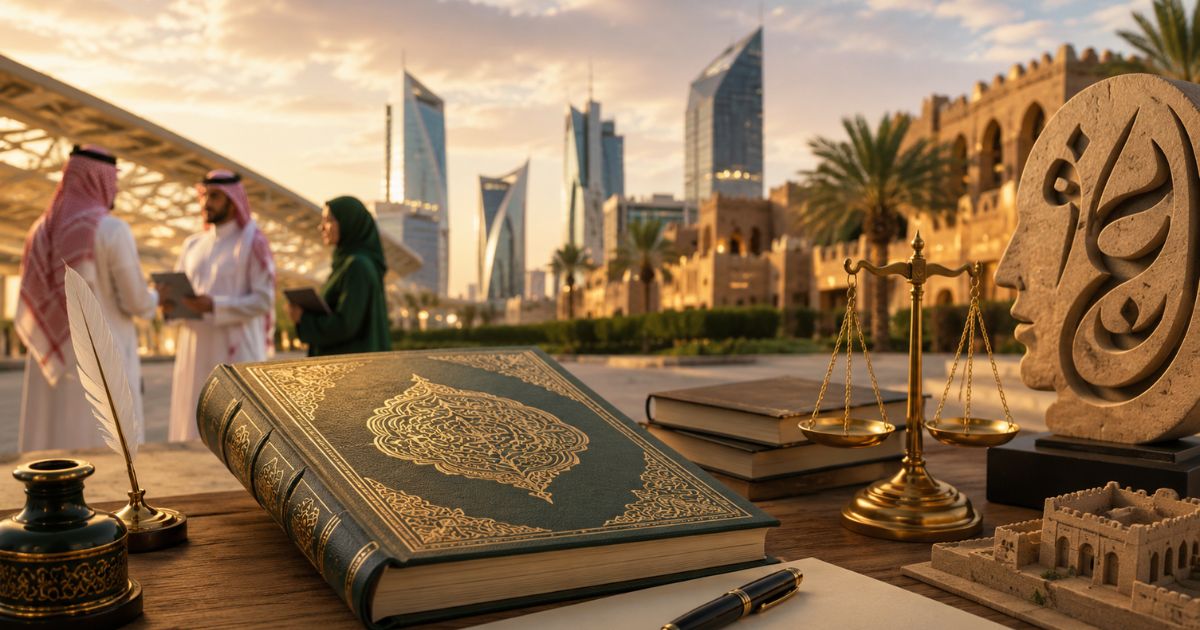
National Policy for the Arabic Language in Saudi Arabia was approved by the Council of Ministers on February 3, 2026, to entrench Arabic as the Kingdom’s official language and strengthen its use across government, business, education and culture. The King Salman Global Academy for the Arabic Language oversees its implementation.
Why the policy exists
The policy aims to protect the linguistic identity of future generations and position Arabic as an element of sovereignty and cultural security. It seeks to build a sustainable relationship between citizens and their language, while reinforcing Saudi Arabia’s role as the primary homeland and global reference point for Arabic.
Core principles
Several principles guide the policy’s rollout across Saudi institutions:
- Arabic remains the Kingdom’s official language, used across all public body activities, with other languages permitted alongside it only when needed.
- Schools use Arabic as the primary language of instruction at every educational stage.
- Public bodies, private companies and non-profits use Arabic in contracts, certificates, signage, invoices, and advertisements.
- Scientific research in language sciences receives greater support and funding.
- Media outlets provide or translate content into Arabic to promote its correct use.
- Businesses apply Arabic in administration, correspondence, and recruitment processes.
- Saudi delegations use Arabic in international meetings, conferences and forums.
A long history of protecting Arabic
Saudi Arabia’s interest in the Arabic language dates back to the founding of the state itself. Founding King Abdulaziz bin Abdulrahman Al Saud issued a Royal Order on September 18, 1932, renaming the Kingdom of Hejaz and Najd to the Kingdom of Saudi Arabia, placing “Arabic” as its first descriptor.
A Council of Ministers decision from January 30, 1978, required foreign companies operating in the Kingdom to correspond with government bodies in Arabic, with penalties for violators. Since then, close to two hundred decisions have reinforced Arabic’s use across media, trade, and the judiciary. The Basic Law of Governance, issued in 1992, later confirmed Arabic as the Kingdom’s official language in its founding text.
Frequently asked questions
When was the National Policy for the Arabic Language approved?
The Saudi Council of Ministers approved it on February 3, 2026.
Which body oversees the policy?
The King Salman Global Academy for the Arabic Language supervises its implementation.
Which sectors does the policy cover?
It applies across the governmental, private, and non-profit sectors.
The policy complements other 2026 cultural initiatives, including the launch of the Riyadh University of Arts, which trains Saudi talent partly through Arabic-language instruction. Readers interested in the roots of these efforts can also explore the history of Saudi Arabia.
Official texts and gazette notices are published through the Umm Al-Qura Gazette. Follow KsaPoint on Telegram for more updates on Saudi cultural policy.
