
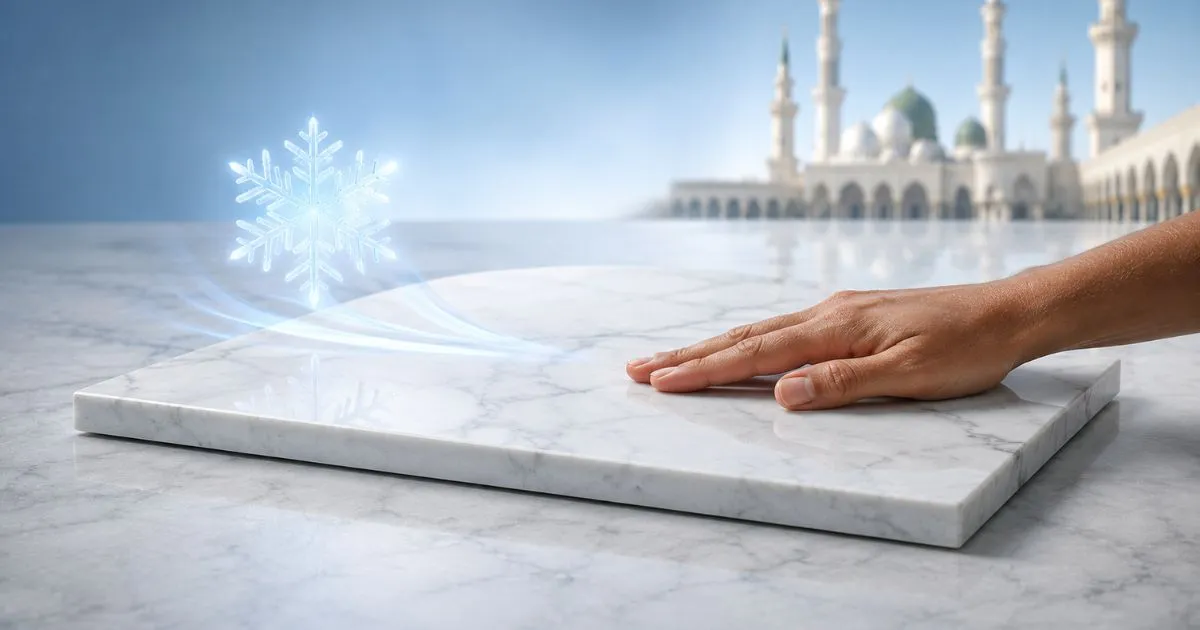
The Two Holy Mosques marble is one of those details worshippers feel before they think about it. Millions walk barefoot across open courtyards in Makkah and Madinah at the hottest hours of the day, and the stone under their feet stays comfortable. That is a material choice, made deliberately, and tested against the local climate.
Every material used in the Grand Mosque and the Prophet’s Mosque is selected against the conditions it has to survive. Stone is no exception. The courtyards are exposed for most of the daylight hours, so the surface has to resist heat rather than store it.
What makes Two Holy Mosques marble different
The courtyards and open surfaces use Thassos marble, a white natural stone from Greece imported specifically for the Two Holy Mosques. Its defining property is that it does not absorb heat during the day, no matter how intense the sun becomes.
There is a second mechanism at work overnight. The stone draws in moisture through fine pores while temperatures drop. During the day it releases that stored moisture and the process keeps the surface cool even as air temperatures climb.
Where Two Holy Mosques marble is used
Thassos stone covers the courtyards and exposed surfaces. Inside the Prophet’s Mosque, the flooring uses Italian Carrara marble, chosen for its quality and laid across an area of more than ninety thousand square meters.
Both stones are matched to the surrounding designs, since floors, walls and surfaces have to read as one scheme rather than a patchwork. All marble used is checked against the required quality standards before installation.
Cooling beyond the stone
Stone alone does not carry the whole load. Fans fitted with water mist systems are deployed to bring down ambient temperatures in crowded open areas, particularly during peak seasons when the courtyards fill well beyond normal capacity.
Those systems sit alongside the wider operational effort during Hajj and Ramadan, from pilgrim transport arrangements to connectivity services across the holy sites. The scale is easy to underestimate until the crowd numbers are read together, as in the year 13 million worshippers prayed at the Rawdah Sharif.
Key takeaways
- Thassos marble from Greece covers the courtyards and does not absorb daytime heat.
- The stone takes in moisture at night through fine pores and releases it during the day.
- Carrara marble from Italy covers over ninety thousand square meters of the Prophet’s Mosque flooring.
- Mist fans reduce ambient heat in addition to the stone’s own properties.
Frequently asked questions
Which marble is used in the courtyards of the Grand Mosque?
Thassos marble, a white natural stone imported from Greece specifically for the Two Holy Mosques.
Why does the marble not get hot?
It resists heat absorption during the day and it releases moisture absorbed overnight through its fine pores, which keeps the surface cool.
What marble covers the Prophet’s Mosque floor?
Italian Carrara marble, laid across more than ninety thousand square meters.
A detail worth noticing
Material selection at this scale is quiet engineering. It shows up in the same way across the holy sites, from the Ramadan enrichment programs to the leadership of figures such as Sheikh Abdulrahman Al-Sudais. Visitors planning a trip often pair the mosques with ziyarat sites in Makkah, the wider Makkah Province and the history of Al-Madinah Al-Munawwarah.
Stay Updated
🔔 Follow us for latest news and guides:
✅ WhatsApp Channel
☑️ Telegram Channel
